For years I've been trying, with no luck, to get the City of Toronto to answer two simple questions:
Sometimes physical differences can lead us to remarkable new discoveries. My sensitivity to bright light drove me to invent smartglasses in the 1970s and the HDR photography/videography that it uses to help me see[1]. I'm good at seeing the future. In my childhood in the 1960s and 1970s I predicted most of us would have a single device that allows us to capture, record, and share sound, pictures, and video.
I also predicted we'd be fighting over water access. More recently, due to a back injury, my own accessibility issues have given me a unique view into hidden and invisible barriers blocking us from that very access to water.
My wife and I chose to live and start a family by Lake Ontario in downtown Toronto, the largest city on the Great Lakes which hold one-fifth of the world's (85% of North America's) freshwater. Toronto is the capital of Ontario which is home to the world's largest freshwater lake. The word Ontario is an Indigenous Iroquoian and Huron word meaning "sparkling water", "beautiful lake", and "great lake".
In this sense Toronto is the freshwater capital of the world. For many of us, the nearby Ontario Place was our summer cottage until our provincial government decided to privatize it. Under cover of darkness on the night of Wednesday, October 2, 2024, they clearcut its forest, destroying 865 trees overnight to prepare the site for a private indoor waterpark and spa project by Therme Canada.
That left many of us searching for other water access in downtown Toronto. In my lab, as well as some of Toronto's best and most accurate testing labs, we began testing water from various waterfront locations and found some really good places to swim, but City bylaws forbid swimming anywhere other than designated lifeguarded beaches, none of which are located near downtown Toronto (e.g. walking distance from University of Toronto or the CN Tower).
Many other great cities around the world are becoming "Swimmable Cities", except for Toronto. For example, Paris, France, is now a place where people can legally swim in the Seine right next to the Eiffel Tower. This free swimming area has changing rooms, showers, and stunning views of the Eiffel Tower.
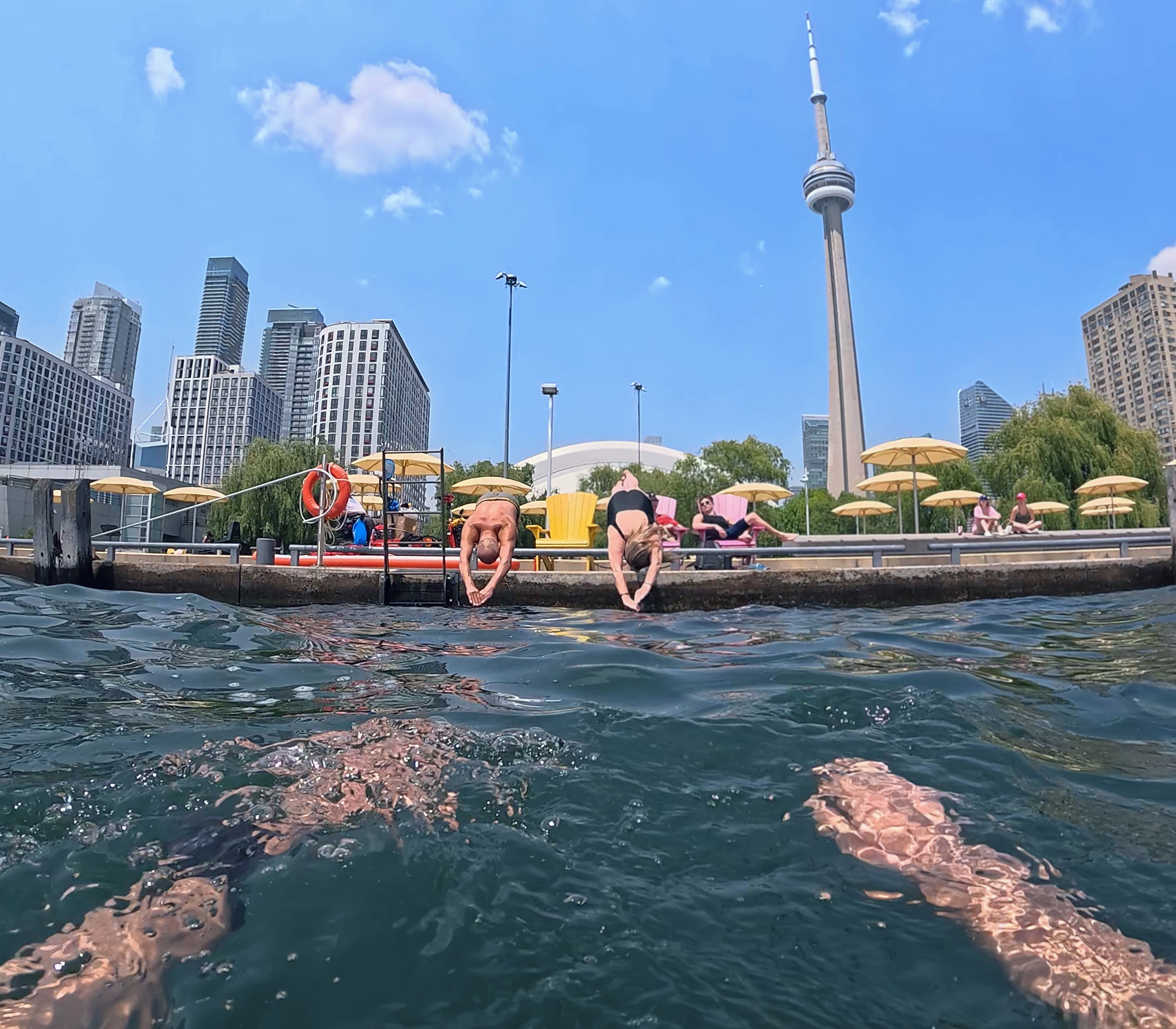
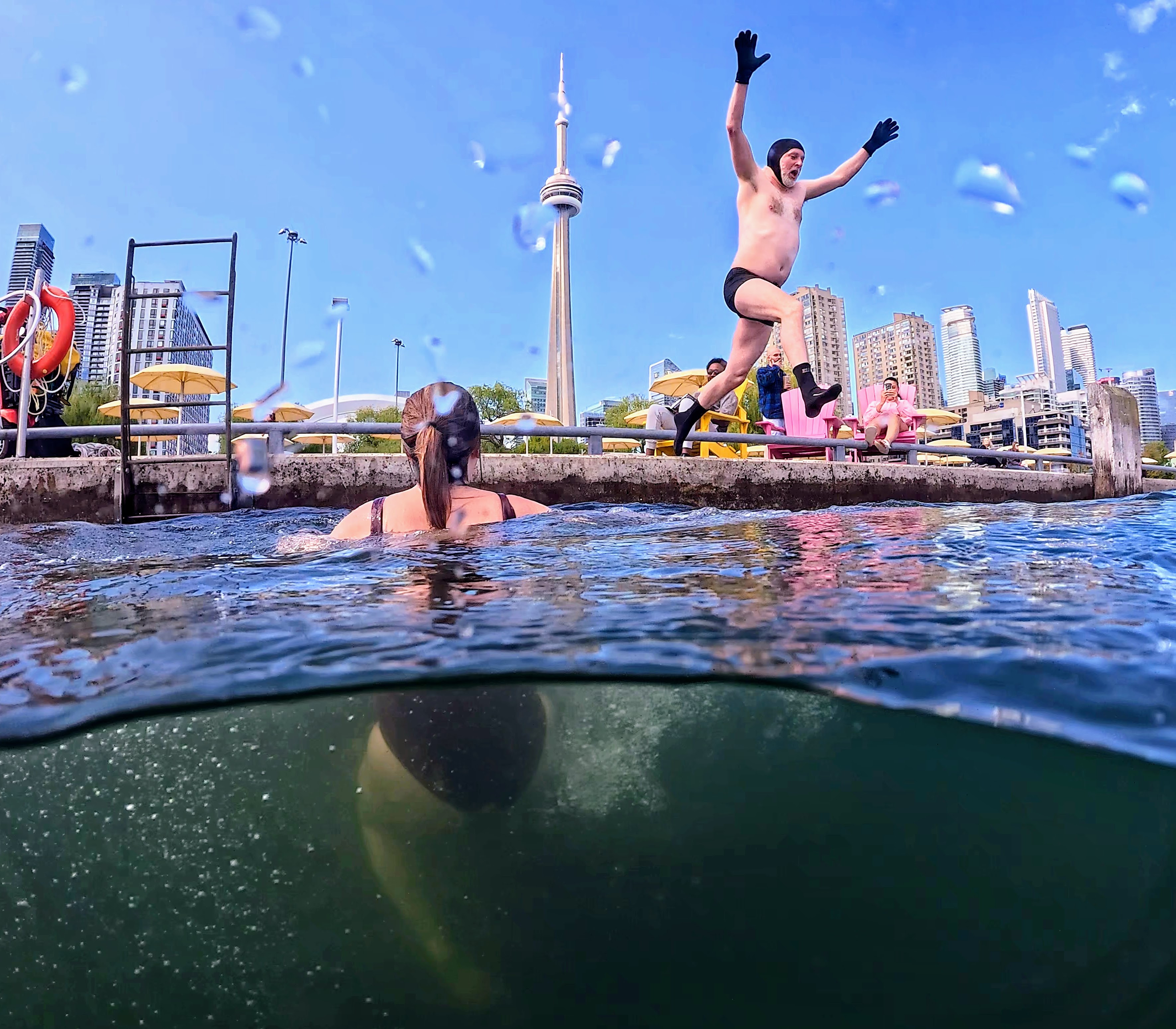
Many people come to HTO Beach to swim in front of Toronto's CN Tower,
ignoring the "NO SWIMMING" signs:
Our waterfront has not only fallen to neglect, but deliberate actions are being taken to block public water access. I call these deliberately-constructed accessibility barriers, "Blue Barriers".
A glaring lack of safety is one such barrier. The deteriorating condition of the safety
ladders along the downtown
waterfront makes it dangerous for anyone falling in from the
shore, or from a vessel, as well as dangerous for paddlers and other
recreational water-users in distress:
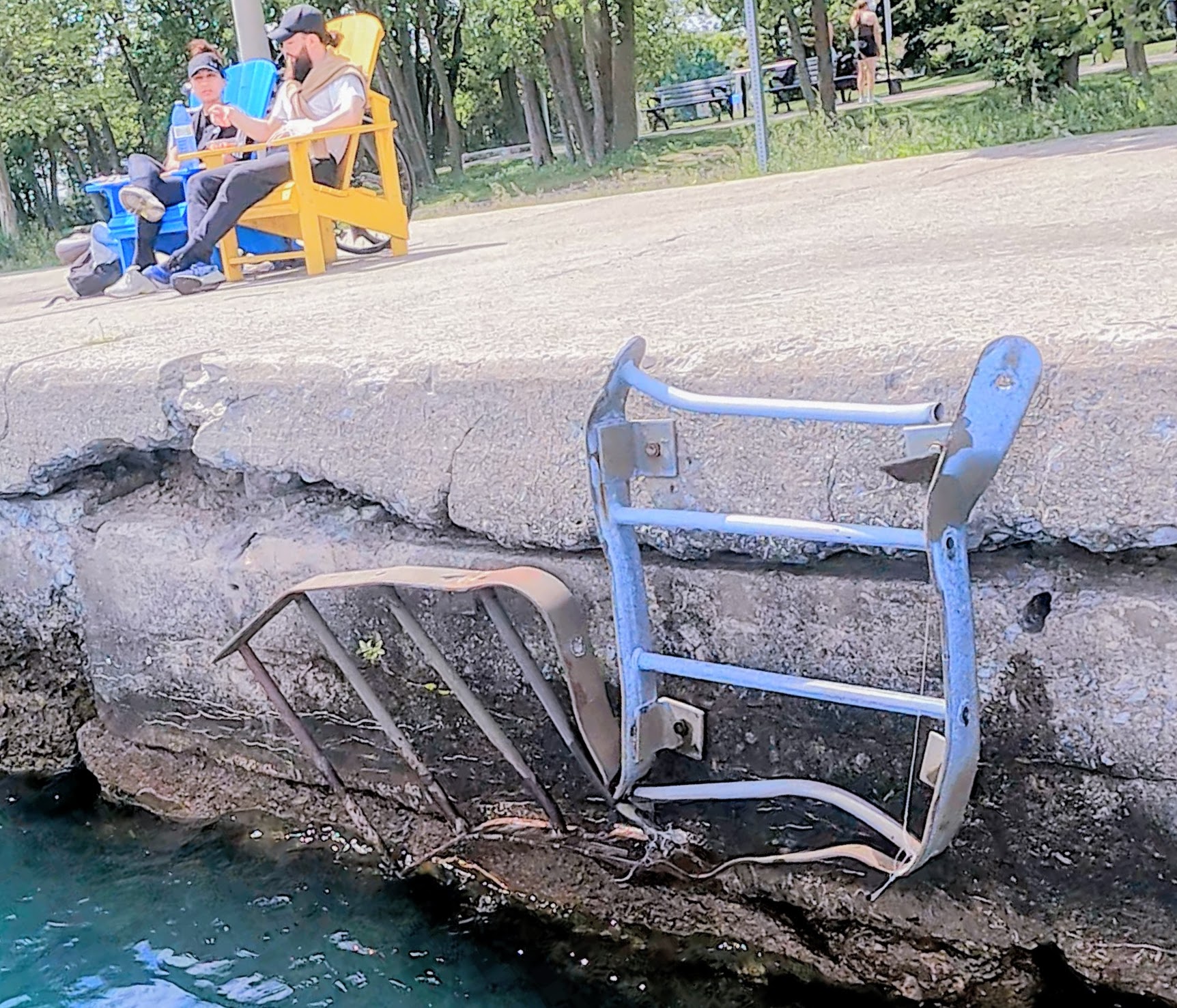
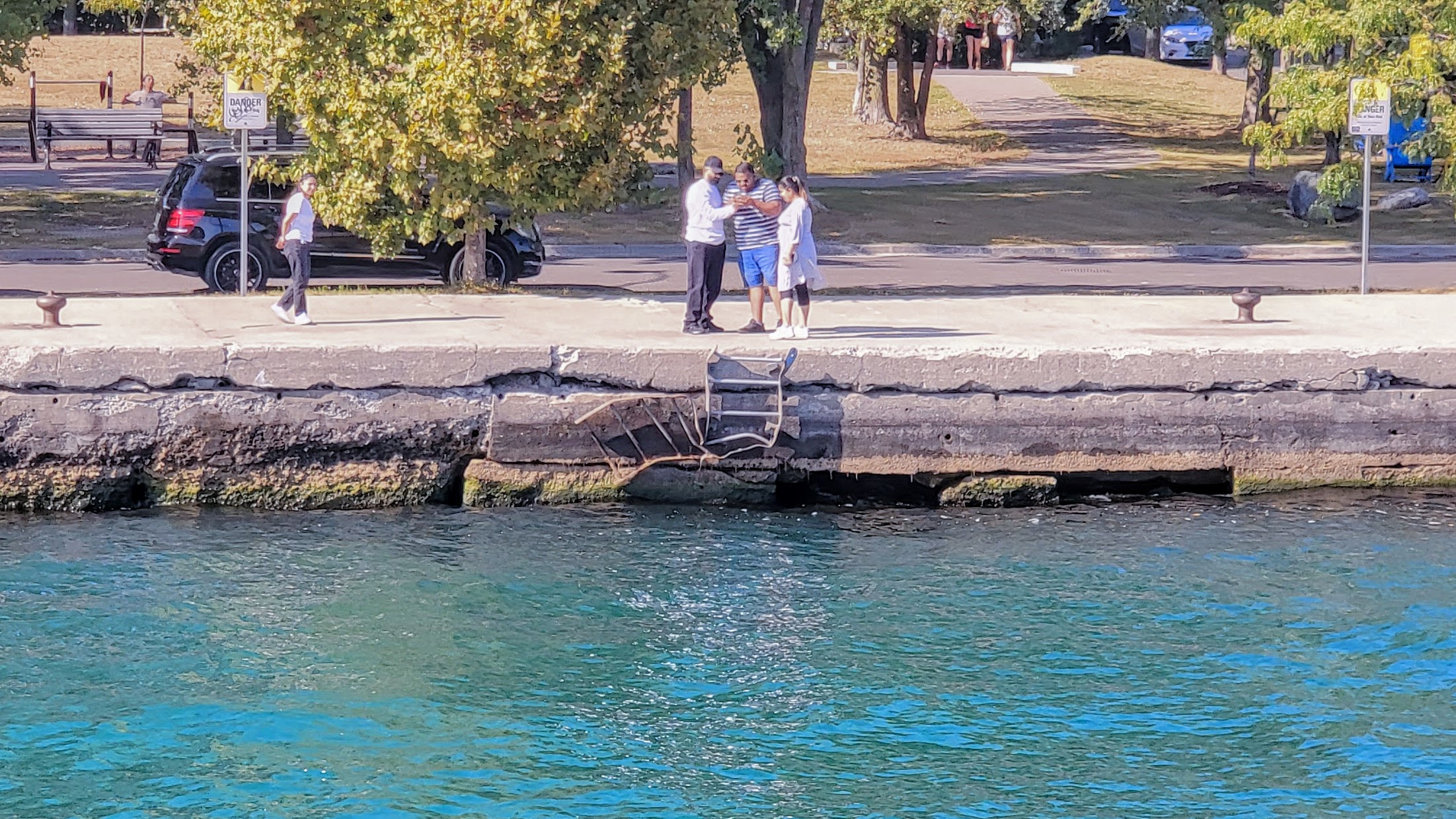
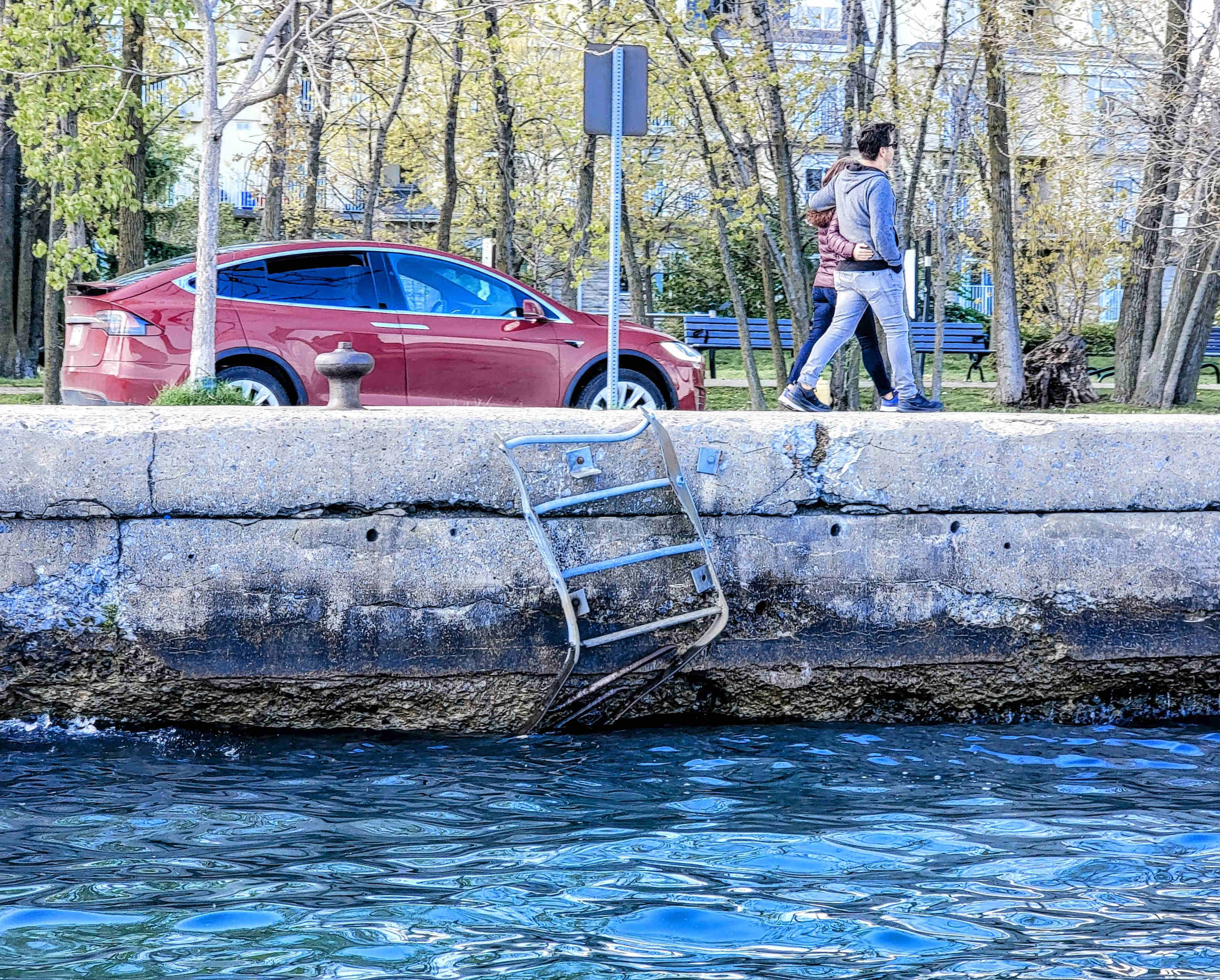
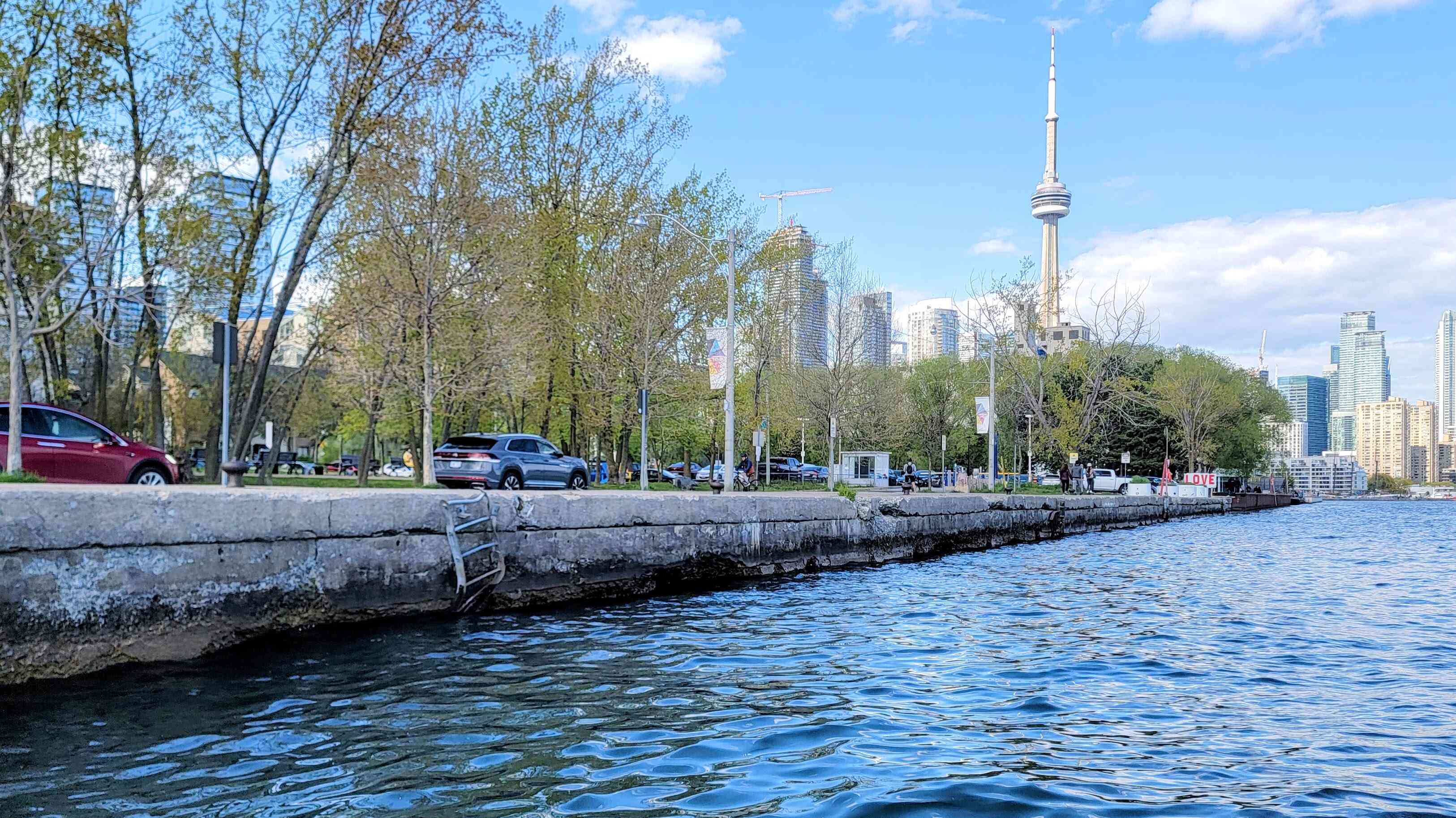
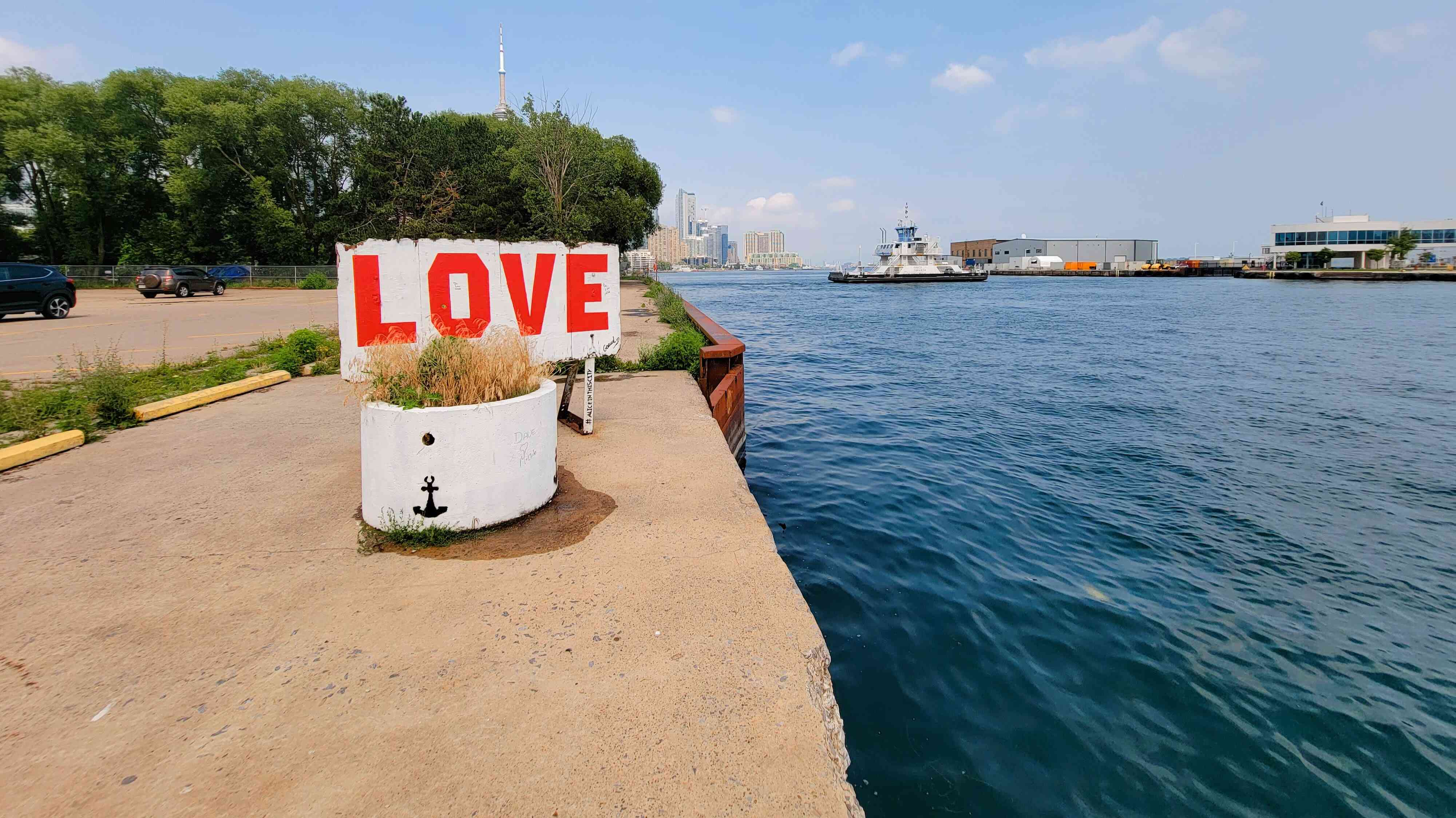
Safetyladders along
LoveQuay,
a popular swim spot next to National Yacht Club
For years we have been trying to get the City of Toronto to provide a safe waterfront but they've simply passed the buck, refusing to accept responsibility. The waterfront has become a liminal space, a bit like the Wild West, where no specific entity wants to claim responsibility or accept liability. For many years we're approached all 3 levels of government as well as Waterfront Toronto, Toronto Port Authority, Harbourfront, and anyone else who would listen, but to no avail.
As a result of this inaction, grassroots groups have risen to the occasion as defenders of our waterfront. Organizations like Waterfront for All have joined the fight, and yacht clubs have installed their own safety ladders or maintained existing ones. Harbourfront, rather than the City, also put safety ramps into the Peter Street Basin.
However, under the direction of Andrea Chow, Manager of Parks, City of Toronto, these vital safety ladders and ramps are being deliberately removed, actively endangering the public:
Andrea Chow
Thu, Jul 9, 1:19 PM
Good afternoon Steve,
[...]
The ramps and ladders that were installed at the Peter Street Basin without authorization have been removed
The Chow administration is also attempting to assert its ownership and jurisdiction over navigable waters:
Neither the Peter Street Basin, nor HTO are designated swimming or paddle areas. The City does not authorize swimming or paddling in these locations.
...
Should you wish to swim or paddle in open water in Toronto, we encourage you to
go to one of the City of Toronto’s ten designated swimming beaches. Each of
these locations is equipped with beach mats for increased accessibility.
...
Best regards,
...
Andrea Chow
This brings us to a staggering contradiction in City policy. The City has decriminalized drugs and provides safe supervised consumption sites for crack cocaine, fentanyl, and the like advertising them as:
"Supervised consumption sites and services Safe, clean space
for people to bring their own drugs to use, 24 hour services"
How about decriminalizing water? The Huberman Lab at Stanford and many others have shown that cold water swims provide a massive dopamine release comparable to cocaine, making it a highly effective transition tool for those in recovery. This isn't just a theory, it is happening right here in Toronto. The SwimOP (Ontario Place) community has gorwn to over 5000 members, and approximately 50% of them are former drug users who have successfuly switched to cold water plunges to manage their recovery. Cold water swimming has saved countless lives!
If the City provides infrastructure, funding, and safe spaces to support drug consumption, it defies logic to criminalize and dismantle the infrastructure that is actively keeping thousands of our citizens off drugs. Yet, if someone wants to transition from cocaine to cold-water swimming, the Chow administration will stand in their way. Providing the same infrastructural support or at the very least, safe, unimpeded access, to natural cold-water sites is a public health imperative.
We should not need to keep a constant watch for marine police boats while entering police-infested waters, as the Chow administration regards water use as illicit. Most notably, the Chow administration has been discouraging winter swimming, which, should simply be "swim at your own risk" as obviously no lifeguards are on duty in the winter time.
Safe-consumption sites for cold plunges (cold-water exposure) in downtown Toronto is a very reasonable ask.
Or how about leave them unsupervised for use at one's own risk? That's an even easier ask.
Just stop hassling us for accessing our lake!
Other cities like Kingston simply have signs stating "SWIM AT YOUR OWN RISK" around the downtown
core, at places like the Gord Edgar Downie Pier, a deep-water
urban natural swimming pier that was inspired by, and designed by the same
architect as Toronto's HTO Beach.
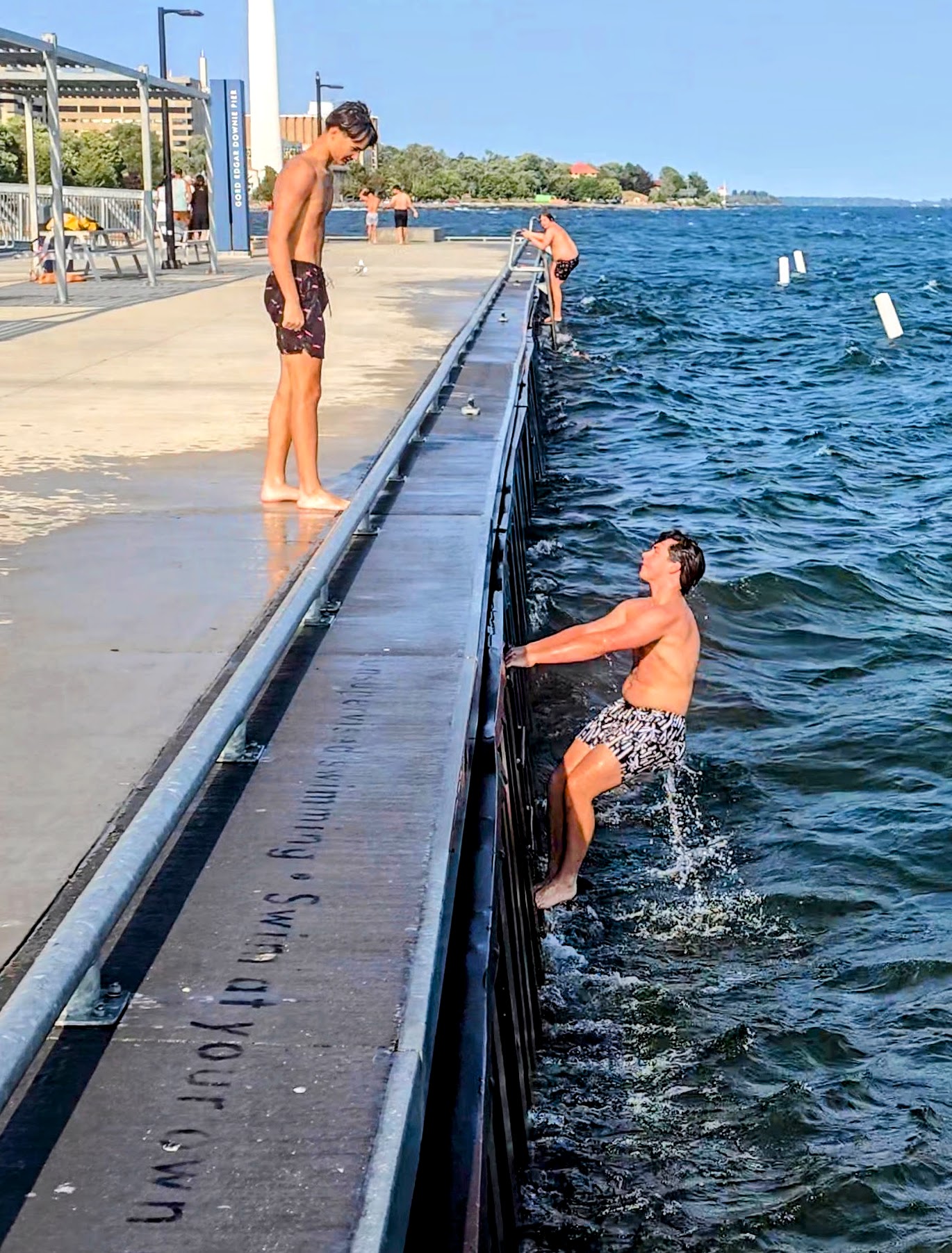
Kingston's deep-water urban natural swimming piers
are labeled: "Unsupervised swimming. Swim at your own risk." and were modeled after Toronto's HTO Beach by the same architect.
On Thu, Jul 9, 2026 at 2:36 PM Andrea Chow wrote:
    Hi Steve,
[...]
As to HTO Park, the use of non-motorized watercraft off the dock wall is not permitted subject to Parks by-law 608 for safety reasons.

There is accessible beach matting at all 10 Supervised Swimming Beaches in Toronto.
I have a disability due to a back injury and use a standup mobility aid
so I can't cross beach sand. None of the accessible beach matting
provided by the City of Toronto is functional. It is dangerous and does not
reach the water. It only allows people with disabilities to look at the water from a distance.
In fact, I was injured and my mobility device was damaged trying to access the
water using the "accessible beach matting"
at Sunnyside beach (2026 July 11),
which turned out
to be slippery, too steep, and improperly installed with
sharp jagged screw fittings exposed.
Moreover, the City has constructed barriers ostensibly to keep bicycles off the boardwalks,
but they actually just keep mobility devices off the boardwalks while failing to stop
bycycles:
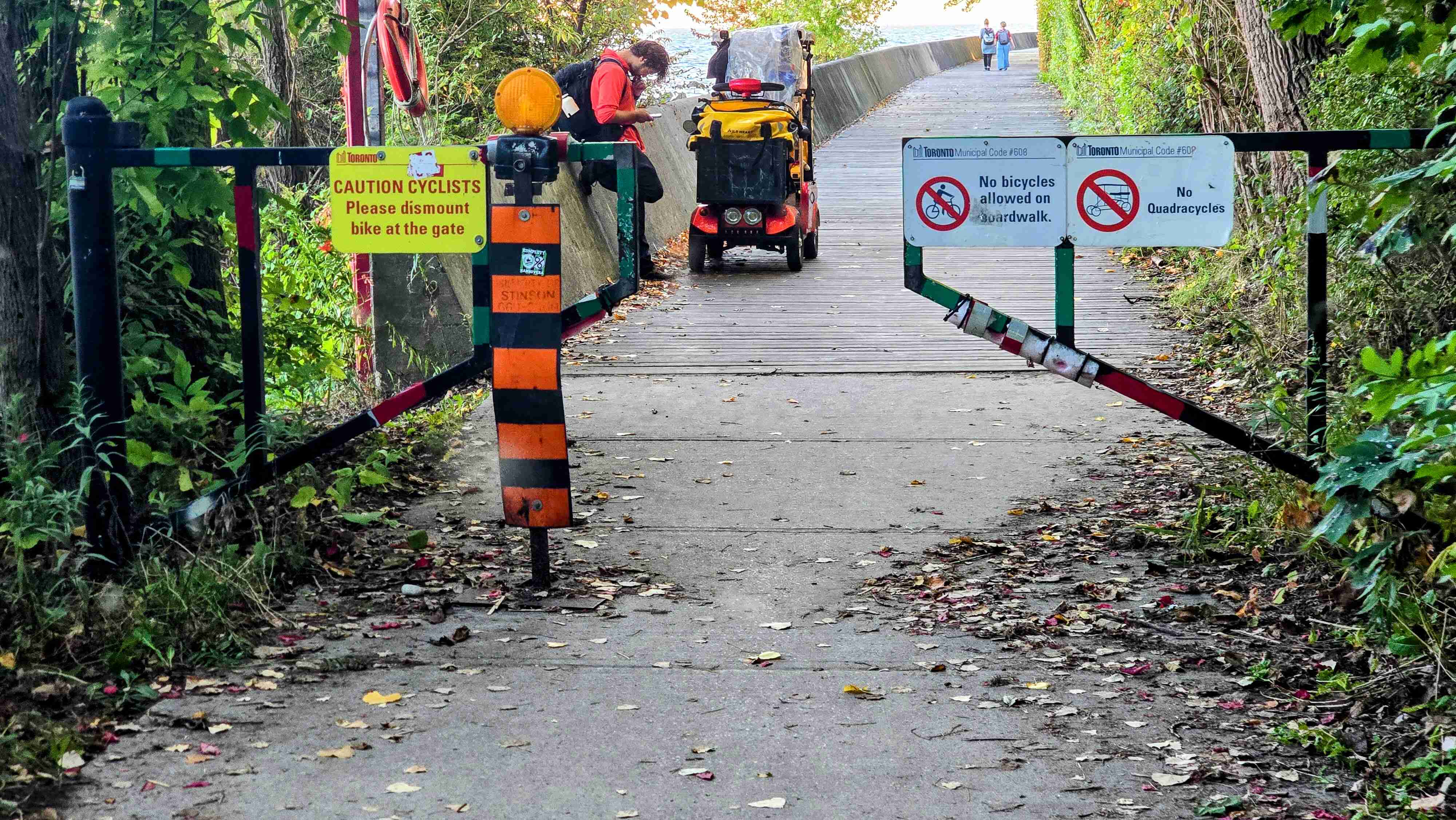
I inquired to City of Toronto in 2023 about this, and Andrea Chow responded Oct. 14, 2025 "I will need to do some follow up regarding the boardwalk.". To this day, these Blue Barriers remain, and I have received no word on whether wheelchairs and mobility devices are allowed on the boardwalk.
So the only accessible beach in Toronto in which a person can get a mobility device all the way to the water's edge is HTO Beach, where only motorboats are allowed, according to Andrea Chow.
The boardwalk there actually hangs over the water, and is part of the same Ontario land registry parcel as the Inner Harbour. Therefore I doubt Chow's claim is valid. However, to humour her, and perhaps exercise my own sense of humour, I created the "Chow Motor" (#ChowMotor).
As a professor of electrical engineering who teaches electric motors,
I have many small motors that come in boxes of 480.
I simply installed one on my paddleboards to legally transform it into a "motorboat".
The motor consumes about 0.0003 horsepower (5 volts at 0.05 amps)
but very little of that power actually propels the boat. The propulsion is less than a millionth of
a horspower, i.e. less than one microhorse, because there is no
propeller. Moreover, the motor is seldom turned on.
It is simply a "compliance motor" installed purely so that I can continue to access the lake
at the only place where the lake is physically accessible to me:
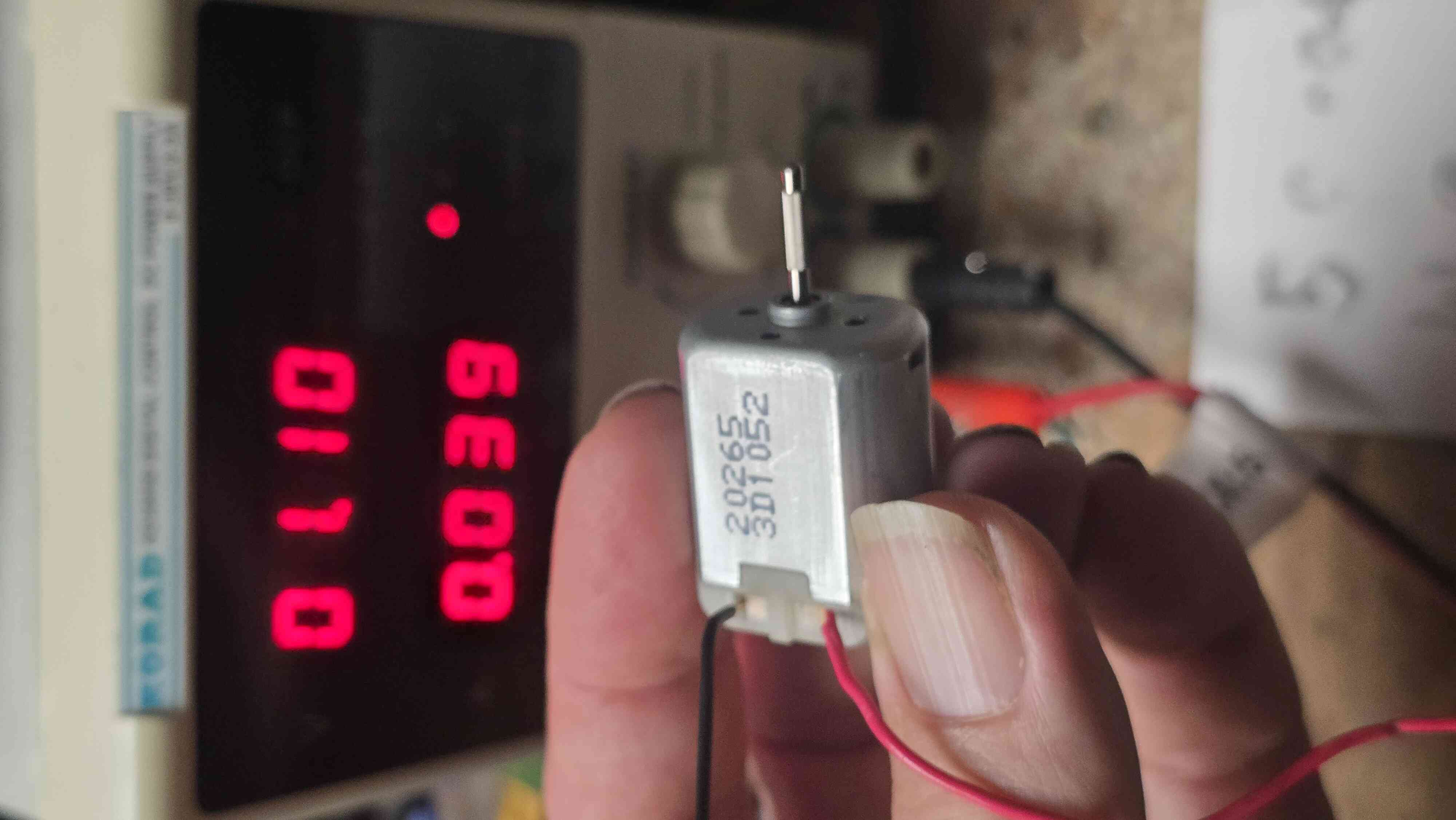
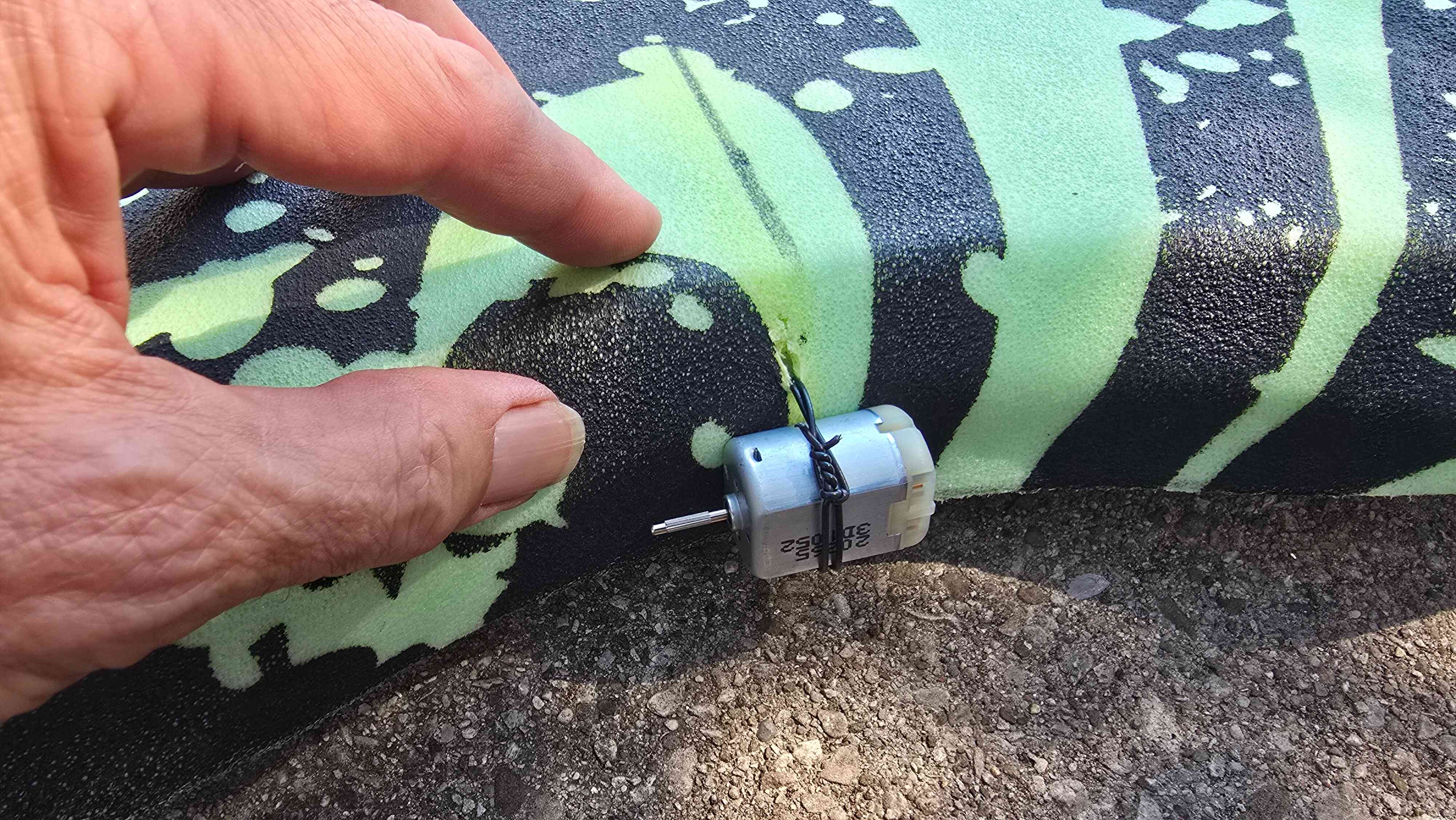
The "Chow-motor" or "Compliance-motor" is a motor attached to a
paddleboard so that it can be called a "motorboat". It need not
actually run..
The fact that I have installed meaningless motors onto a HUMAN-POWERED water device in order to comply with the 'Chow rules', shows that the rules themselves are, in effect, meaningless. Why does the City of Toronto spend time and resources in 'enforcing' meaningless regulations, instead of encouraging its citizens to use and enjoy the waterfront?
My doctor also prescribed water-walking for spinal rehab, a treatment my chiropractor and occupational therapist also support. Yet the City of Toronto will not allow a water-walker in any of their pools.
Looking for alternatives, I discovered an outdoor pool that is part of Lake Ontario.
It was covered in so much garbage that one could not even see the water.
So we formed a volunteer Cleanup Crew and cleaned it up
to the point where it was safe for swimming. We turned
Peter Street Basin into Peter Street Pool, Toronto's downtown Lake Lido:
It was swamped with garbage. Now there are swimmers in this Toronto lake basin
It is now suitable for water-walking exercises for people with disabilities, for spinal rehab., etc. [2].
Perhaps our efforts are the exact reason the Chow administration removed the safety ladders and ramps from Peter Street Basin, and put up "NO SWIMMING" signs there, and tried to prohibit "non-motorized watercraft" there and at HTO Beach.
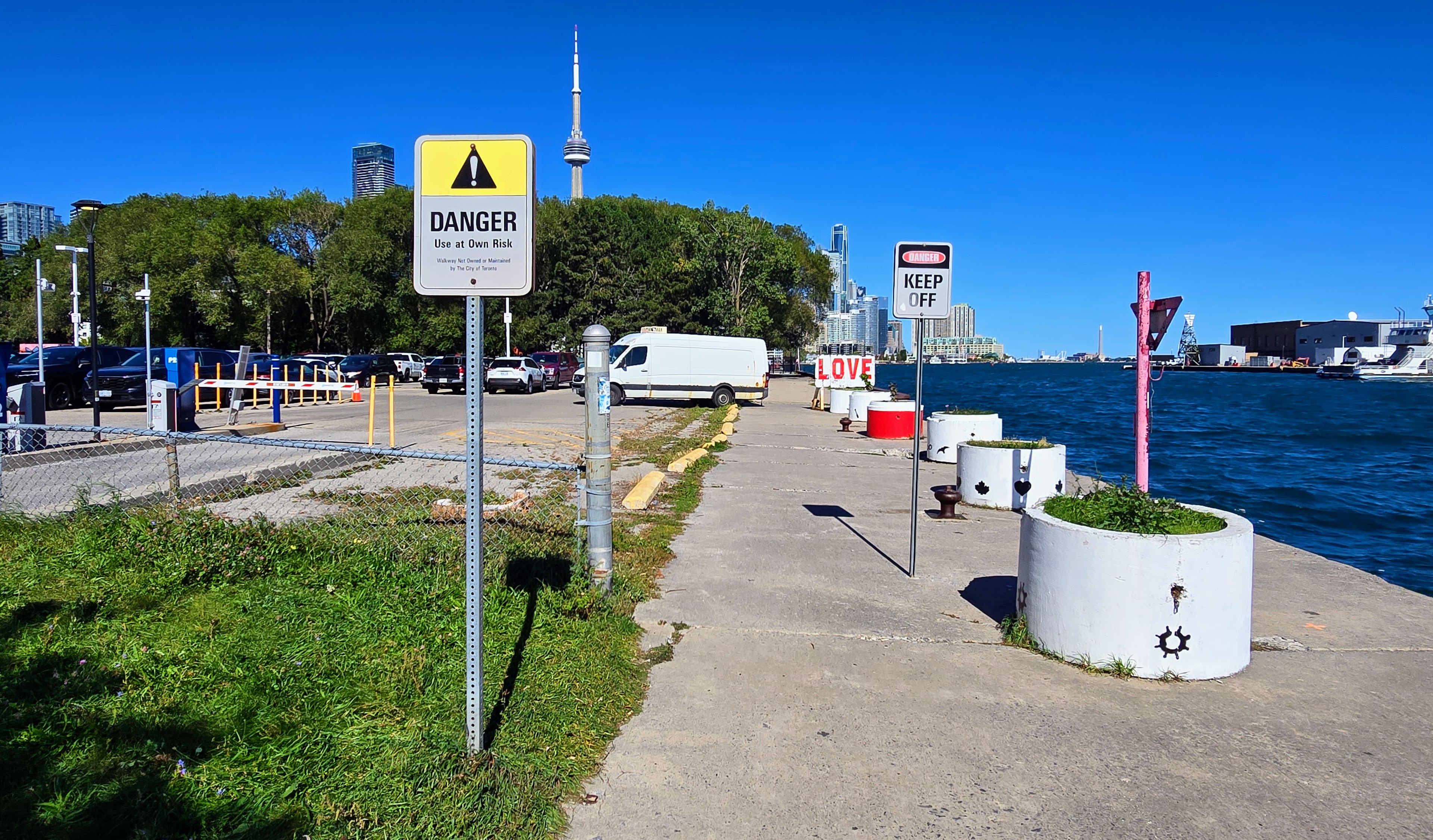
LoveQuay is located right beside a large public parking lot which is directly adjacent to the walkway, just 7 meters (about 23 feet) from the water's edge. Think about that: here we have possibly the only place in Toronto where you can park less than 2 car-lengths from the water's edge! That's a nice easy short carrying distance with a canoe, kayak, or paddleboard, i.e. about two kayak or paddleboard-lengths from the water's edge! Where else in Toronto can you park all day only several paces from the water's edge?
Finally, half jokingly, we asked if we need permission from the United States government to jump in the lake, if they think they own it ("Lake America"). Previously there were six organizations we'd need permission from: City, Province, Canada, WATERFRONToronto, Harbourfront, and Toronto Port Authority. Now maybe there's a seventh, namely international law and politics.
Since the safety ladders are in disrepair at LoveQuay, new ones were added by non-City-of-Toronto entities and Andrea Chow has not yet had them removed. Let's hope it stays that way -- a Chow-free space, ungoverned, and therefore safer and more accessible. The community has provided what the government has taken away from us: accessibility! In this strange situation, government bureaucracy might be helping keep us safe, with Toronto's own "immovable ladder" held to the dockwall with not just bolts, but with a byzantine web of confusion over ownership and jurisdiction keeping the Chow administration from removing the safety-ladder.
We want safe access to clean water downtown where we live and work. We want Half-hour Cities where you can get anywhere on foot in 30 minutes or less. Let's put an end to urban sprawl and make our downtown waterfront clean, safe, and truly accessible.
Brad Bradford, the Toronto City Councillor for The Beaches, brought forward "Safer Shores...", a motion to create safety zones, motorized watercraft ban and exclusion zones at local beaches like Woodbine and Cherry beaches to protect swimmers and paddlers from illegal jet ski activity. Brad's motion was accepted unanimously at Council.
Will the Chow administration show an equal or greater desire for a safer and more accessible waterfront?
It is time to put Breaking Blue Barriers on the Balletbox
Thanks to Jeff Archobold and Tyrone Moodly for many suggestions on this writing.
*Chow here refers to Andrea Chow, Parks-Waterfront District Manager, not to be confused with Olivia Chow (Mayor) who remains a friend of our family but does not appear to have carriage of the matter referred to herein.