Lightvectoring (painting with lightvectors):
Anti-homomorphic vectorspaces as visual art
Steve Mann
mann@eecg.toronto.edu
University of Toronto,
10 King's College Road,
Toronto, Ontario,
Canada, M5S 3G4
Abstract
The research described in this paper arises from the author's work in designing
and building a wearable graphics production facility which he has used
to create a new kind of visual art over the past 15 or 20 years.
This work bridges the gap between computer graphics, photographic imaging,
and painting with powerful yet portable electronic flashlamps.
Through the use of an anti--homomorphic filter,
principles of anti--homomorphic superposition and anti--homomorphic
vector spaces are used to create a new kind of image content
within a community of users sharing a commonly altered visual perception
of reality. The apparatus for altering the visual perception of reality
forms a useful interface to collaborative production of artwork that
is viewable in realtime on the Internet while it is being created.
Keywords:
Comparametric Equation, Comparametric Plot,
Image processing, Personal Imaging, Wearable Cybernetics,
Wyckoff principle, photography,
lightspace, photoquantigraphic imaging
Photographic Origins of
Wearable Computing and Augmented/Mediated Reality in the 1970s
and 1980s
The Reality Mediator (RM)
has, in recent years, received considerable attention in
military applications as well as in industry.
However, the original Personal Imaging application of the RM
(cite mann97, IEEE Computer)
was an attempt to define a new genre of imaging
and create a tool that could allow reality
to be experienced with greater intensity and enjoyment
than might otherwise be the case.
This effort also facilitated a new form of visual art
called Lightspace Imaging (or Lightspace Rendering) in which
the author chose a fixed point of view for the camera, and then,
once the camera was secured on a tripod, the author walked around
and used various sources of illumination to sequentially
build up an image layer-upon-layer in a manner
analogous to paint brushes upon canvas, and the cumulative
effect embodied therein.
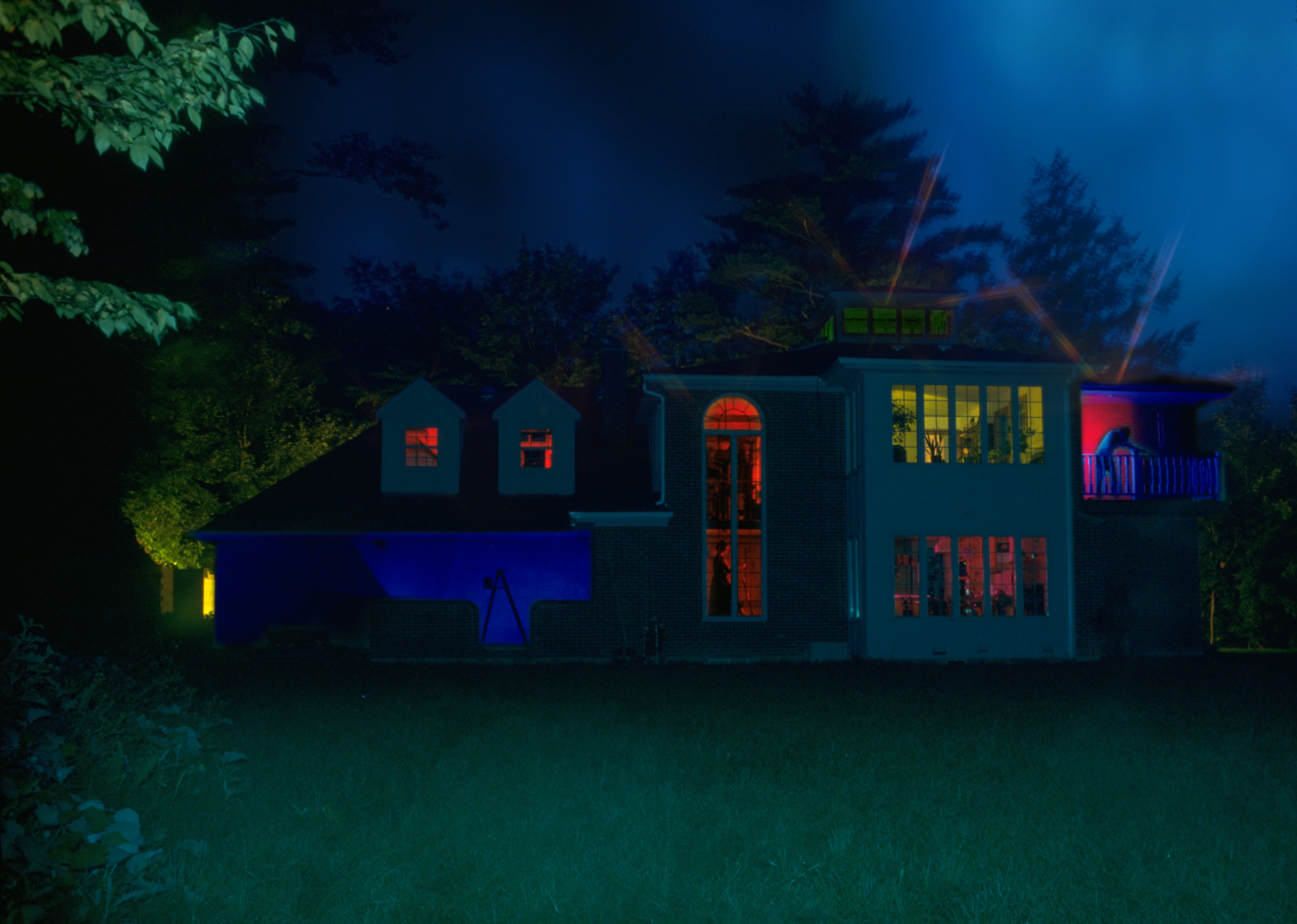
The author's early 1980s attempts at creating expressive images using
the personal imaging system he developed in the 1970s
and early 1980s are depicted in
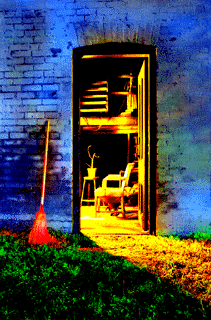 Figure 1a
and Figure 1b.
Figure 1a
and Figure 1b.
CAPTION:
A common criticism of the camera
is that it reduces our enjoyment of
reality because we become so busy working the camera that
we neglect to appreciate reality itself.
However, a goal of
Personal Imaging
is to create something much more like
the sketch pad or artist's canvas than
like the camera in its usual context.
The images produced as artifacts of Personal Imaging
are somewhere at the intersection of
painting, computer graphics, and photography.
(Figure 1a)
Notice how the broom appears to
be its own light source (e.g. self-illuminated), while the
open doorway appears to contain a light source emanating from
within. The rich tonal range and details of the door itself,
although only visible at a grazing viewing angle, are
indicative of the affordances of the
Lightspace Rendering method.
(Figure 1b) architecture offers a unique perspective, which can also be
illuminated expressively.
(C) Steve Mann, 1984.
Throughout the 1980s, a small number of other artists also used the
author's apparatus to create various lightpaintings. However, due to the
cumbersome nature of the early WearComp hardware, etc., and the fact that
much of the apparatus was custom fit to the author, it was not widely used
over an extended period of time by others.
However, the personal imaging system proved to be a new and useful
invention for a variety of photographic imaging tasks.
To the extent that the artist's
light sources were made far more powerful than the natural ambient light
levels, the artist had a tremendous degree of control over the
illumination in the scene. The resulting image was therefore a
depiction of what was actually present in the scene, together with
a potentially very visually rich illumination sculpture surrounding
it. Typically the illumination sources that the artist carried
were powered by
batteries. (Gasoline powered light sources were found
to be unsuitable in many environments such as indoor
spaces where noise, exhaust, etc. were undesirable.)
Therefore, owing to limitations
on the output capabilities of these light sources, the art was
practiced in spaces that could be darkened sufficiently, or,
in the case of outdoor scenes,
at times when the natural light levels were least.
In a typical application, the user
positions the camera upon a hillside, or on the roof
of a building, overlooking a portion of
a city, usually having an assistant oversee the
operation of this camera.
The user may then roam about the city, walking down
various streets, and use the light sources to
illuminate various buildings one-at-a-time. Typically, in order that
the wearable or portable light sources be of sufficient
strength compared to the natural light in the scene (e.g.
so that it is not necessary to shut off the electricity to
the entire city to darken it sufficiently that the artist's
light source be of greater relative brightness)
some form of electronic flash is used as the light source.
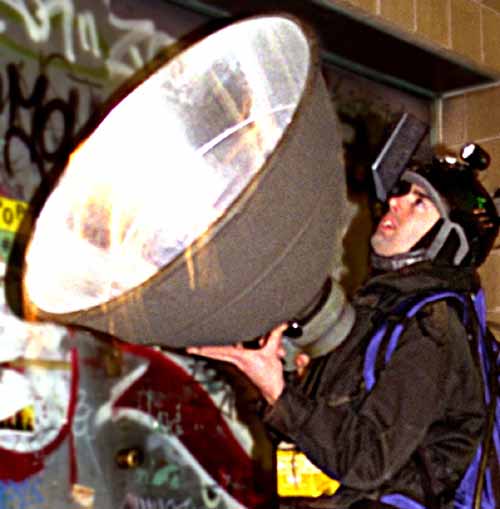
In some embodiments of the personal imaging
invention, an FT-623 lamp
(the most powerful lamp in the world, with output of 40kJ) is
used, housed in a lightweight
30 inch highly polished reflector, with a handle which allows
it to be easily held in one hand and aimed
(Figure 2)
CAPTIOM:
Wearable Computing and Augmented/Mediated Reality
for Computer Supported Collaborative Photography}:
A portable electronic flashlamp is used to illuminate
various buildings such as tall skyscrapers throughout
a city. The viewfinder on the helmet
displays material from a remotely mounted camera with
computer generated text and graphics overlaid in
the context of a collaborative telepresence
environment. An assistant at the remote site wears a similar
apparatus with a similar body-worn backpack-based processing system.
Lightvector amplification
The communications infrastructure
is established such that the camera is only sensitive to light
for a short time period (e.g. typically approximately 1/500 of a second),
during the instant that the flash lamp produces light.
In using the personal imaging invention to selectively and sequentially
illuminate portions of a scene or object, the
user will typically point the source at some object in the scene
in front of the camera, and issue a command through the wearable computer
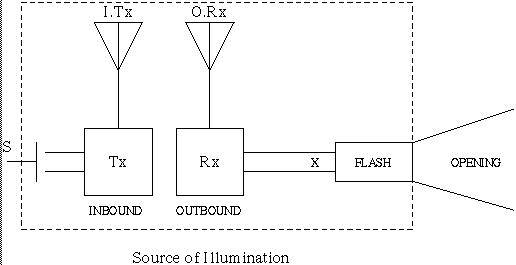
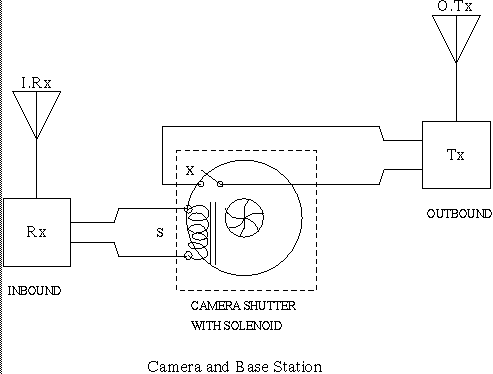
system. A simplified diagram of the architecture is depicted
in Figure 3:
 (a)
(a)
 (b)
CAPTION:
Artist's ``paintbrush''
for Computer Supported Collaborative Photography}:
The artist issues commands to a remote camera
using a data entry device while
monitoring the resulting pictures and overlaid text+graphics
on a head mounted display.
Here a
simplified diagram is used to illustrate signal routing.
(a) When the artist issues a command by switch closures (S),
a signal is sent through an INBOUND communications channel,
depicted as transmitter I.Tx, to the central base station
(b) and is received by the inbound receiver, denoted I.Rx.
This initiates frame capture (depicted by solenoid S) with
a computer system located at the base station.
At the correct instant during frame capture,
a signal (depicted by flash sync contacts X)
is sent back by the camera's outbound
transmit channel O.Tx, to the artist (a)
and received by the artist's
light source synchronization receiver, O.Rx.
This activates FLASH through its synchronization
contacts denoted X. Light then emerges through the OPENING
and illuminates the scene at the exact instant during which
the camera's sensor array is sensitive to light.
A short time later, the image from the camera base
station (b) is sent via the OUTBOUND channel to the artist (a)
and is displayed on the artist's head-mounted display,
overlaid with a calculated summation of previous differently
illuminated images of the same scene
and appropriate graphics for manipulation of the summation
coefficients.
(b)
CAPTION:
Artist's ``paintbrush''
for Computer Supported Collaborative Photography}:
The artist issues commands to a remote camera
using a data entry device while
monitoring the resulting pictures and overlaid text+graphics
on a head mounted display.
Here a
simplified diagram is used to illustrate signal routing.
(a) When the artist issues a command by switch closures (S),
a signal is sent through an INBOUND communications channel,
depicted as transmitter I.Tx, to the central base station
(b) and is received by the inbound receiver, denoted I.Rx.
This initiates frame capture (depicted by solenoid S) with
a computer system located at the base station.
At the correct instant during frame capture,
a signal (depicted by flash sync contacts X)
is sent back by the camera's outbound
transmit channel O.Tx, to the artist (a)
and received by the artist's
light source synchronization receiver, O.Rx.
This activates FLASH through its synchronization
contacts denoted X. Light then emerges through the OPENING
and illuminates the scene at the exact instant during which
the camera's sensor array is sensitive to light.
A short time later, the image from the camera base
station (b) is sent via the OUTBOUND channel to the artist (a)
and is displayed on the artist's head-mounted display,
overlaid with a calculated summation of previous differently
illuminated images of the same scene
and appropriate graphics for manipulation of the summation
coefficients.
The receiver at the camera
is typically embodied in a communications protocol, which
in newer embodiments of the invention runs over
amateur packet radio, using a terminal node controller
in KISS mode (TCP/IP). In the simple example illustrated here,
the RECEIVER activates shutter solenoid S; what is depicted in
this drawing is approximately typical of a 1940s press camera fitted
with the standard 6 volt solenoid shutter release, while in
actual practice there are no moving parts in the camera, and the
shutter is implemented electronically.
The camera is sometimes
designed so that it provides a sync signal in advance of becoming
sensitive to light, so that pulse compression may be used for
the synchronization signal.
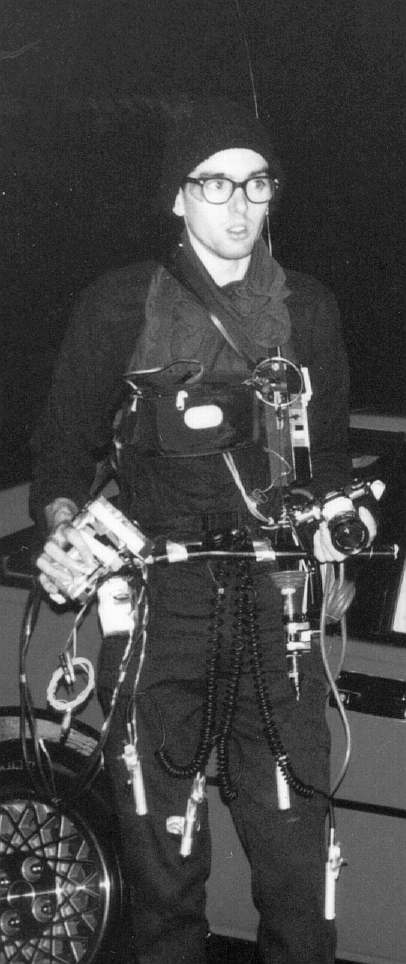
The
wearable computer is generally distributed throughout a
heavy black jacket, and the artist
will typically wear black pants
together with the jacket, and hold the
light source depicted in Figure 3a,
using a black glove, although
this is not absolutely necessary.
Accordingly, the housing of the lamp head will
often be painted flat black.
In this manner a comparatively
small lamp (small compared to the scale of a large city,
e.g. a lamp and housing which can be held in one hand)
may illuminate a large skyscraper or office tower
in such a manner that the lamp appears, in the final image, to be the
dominant light source, compared to fluorescent lights and the like
that might have been left turned on upon the various floors of the building,
or to moonlight, or light from streetlamps which cannot be easily
turned off.
Typically, the artist's wearable computer system comprises a
visual display which is capable of displaying the image from the
camera (typically sent wirelessly over a data communications
link from the computer that controls the camera).
Typically, also, this display is updated with each new exposure.
The wearable computer is generally controllable by the artist
through a chording keyboard mounted into the handle of each
light source, so that it is not necessary to carry a separate
keyboard. In this manner, whichever light source the artist
plugs into the body-worn system becomes the device for
controlling the process.
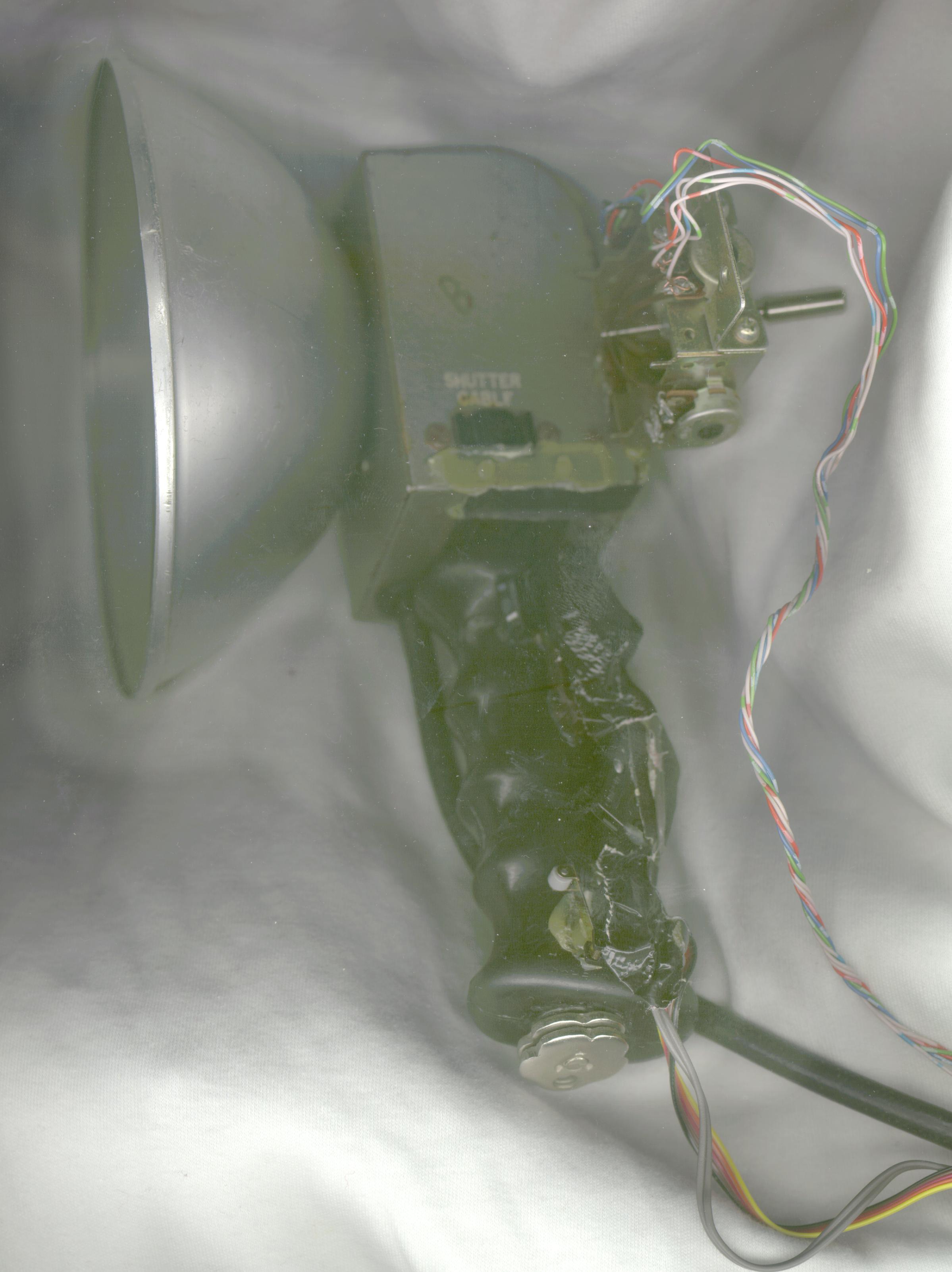
An example of an input device built into the handle of a smaller electronic
flashlamp appears in Figure 4.
CAPTION: Typical ``Keyboard'' and ``Mouse'':
The portable electronic flashlamps used in conjunction
with the invention are each equipped with a data entry
device and cursor pointing device (useful in computer supported
collaborative photography). Here a 1970s system is shown
with five microswitches operable by the right hand while
simultaneously holding and aiming the lamp. Thus it is
possible that one can be walking and entering data at the same
time, or even be climbing a ladder or rope, and stop to enter
data. The pointing device (joystick) is operated with the
left hand so that when ``typing'' and pointing, both hands are
occupied. However since the pointing device is not used frequently
the apparatus is usable with one hand most of the time.
The lamp pictured in Figure~\protect\ref{fig:623}
has a similar user-interface (``keyboard'' for right hand
and ``mouse'' for left hand), except that the left hand
device is also built in proximity to a separate handle/grip
to facilitate two-handed grasping of the lamp in conditions of
high wind. (The 30 inch reflector acts like a sail,
so it needs to
be held with both hands in windy weather.)
Otherwise the two lamps have the same user-interface.
Consistency of user-interface was an important human-factors
consideration.
Typically exposures are
maintained as separate image files overlaid
on the artist's screen (head mounted display) together with the current
view through the camera. The exposures
being in separate image files allows the artist to selectively
delete the most recent exposure, or any of the other exposures
previously combined into the running ``sum'' on the head mounted
display (``sum'' is used in quotes here because the actual
entity, a summation in homomorhic vectorspace,
will be described later.
Additional graphic information is also overlaid to assist
the artist in choice of weighting for manipulation of this ``sum''.
This capability is quite useful, compared to the process of
painting on canvas, where one must paint over mistakes rather
than simply being able to turn off brushstrokes or adjust the intensity
of brushstrokes after they are made.
Furthermore, exposures to light can be adjusted
either during the shooting or afterwards, and then re-combined.
The capability of doing this during the shooting is an important
aspect of the personal imaging invention, because it allows the artist to
capture additional exposures if necessary, and thus to remain
at the site until a final picture is produced. The final picture
as well as the underlying dataset of separately adjustable exposures
is typically sent wirelessly to other sites
so that others (e.g. art directors or other collaborators)
can manipulate the various exposures and combine them in different
ways, and send comments back to the artist by email, as well as by
overlaying graphics onto the artist's head mounted display which then
becomes a collaborative space.
In very recent embodiments (1990s) this has been facilitated
through the World Wide Web.
This additional communication facilitates the collection of additional
exposures if it turns out that certain areas of the scene or
object could be better served if they were more accurately
described in the dataset.
Lightstrokes and Lightvectors
Each of a collection of differently illuminated
exposures of the same scene or object is called a lightstroke.
In the context of Personal Imaging,
a lightstroke is analogous to an artist's brushstroke, and it is the
plurality of lightstrokes that are combined together that give
the invention described here it's unique ability to capture
the way that a scene or object responds to various forms of light.
From each exposure, an estimate can be made of the actual
quantity of light falling on the image sensor, by applying the
inverse transfer function of the camera. Such an estimate is
called a lightvector.
Furthermore, a particular lightstroke may be repeated
(e.g. the same exposure may be repeated in almost
exactly the same way, holding the light in the same position,
each time a new lightstroke is acquired).
These seemingly identical lightstrokes may
collectively be used to obtain a better estimate of a lightvector,
by averaging each of the lightvectors
together to obtain a single lightvector of
improved signal to noise ratio. This signal averaging
technique may also be generalized to the extent that
the lamp may be activated
at various strengths, but otherwise held in the same position and
pointed in the same direction at the scene.
The result is to produce a lightvector that captures a broad dynamic range
by using separate images that differ only in exposure level
(cite
@article{comparam,
  author    = "S. Mann",
  title     = "Comparametric Equations",
  journal   = "{IEEE} Trans. Image Proc.",
  year      = 2000,
  volume    = 9,
  number    = 8,
  note      = "ISSN 1057-7149",
  month     = "August",
  pages     = "1389-1406"}
where the mathematical theory behind this art is described in detail)
Other practical issues of painting with lightvectors
Another aspect of the invention is that the photographer need not work
in total darkness as is typically the case with ordinary lightpainting.
With a typical electronic flash, and even with a mechanical
shutter (as is used with photographic film)
the shutter is open for only 1/500 sec
or so for each ``lightstoke''. Thus the lightpainting can be done under normal
lighting conditions (e.g. the room lights may
often be left on). This aspect of the
invention pertains to both traditional lightpainting (where the
invention allows multiple flash-synched
exposures to be made on the same piece of film, as well as to the use
of separate recording media (e.g. separate film frames or
electronic image captures) for each
lightstroke. The invention makes use of
innovative communications protocols
and a user-interface that maintain the illusion
that the system is immune to ambient light, while requiring no new skills
beyond that of traditional lightpainting.
The communications protocols typically
include a full-duplex radio communications link
so that a button on the flash sends a signal to the camera to make
the shutter open, and at the same time, a radio
wired to the flash sync contacts of the camera
is already ``listening'' for when the shutter opens.
The fact that the button is right on the flash gives the user the
illusion that he or she is just pushing the lamp test button of a flash
as in normal lightpainting, and the fact that there is really any
communications link at all is hidden by this ergonomic user interface.
The invention also includes a variety of options for making the lightpainting
task easier and more controlled. These include such innovations as a
means for the photographer to determine if he or she can be ``seen''
by the camera (e.g. indicates extent of camera's coverage), various
compositional aids, means of providing workspace-illumination that has
no effect on the picture, and some innovative light sources.
Computer Supported Collaborative Art
Finally, it may, at times, be desirable to have a real
or virtual assistant at the camera, to direct or advise
the artist. In this case, the artist's viewfinder which
presents an image from the perspective of the fixed camera also
affords the artist with a view of what the assistant sees.
Similarly, it is advantageous at times that the assistant
have a view from the perspective of the artist.
To accomplish this, the artist has a second camera
of a wearable form. Through this second camera, the
artist allows the assistant to observe the scene from
the artist's perspective. Thus the artist and assistant
can collaborate by exchange of viewpoints, as if each
had the eyes of the other.
(Such a form of collaboration based on exchanged viewpoint
is called {seeing eye to eye}\cite{mann260}.)
Moreover through the use of shared cursors
overlaid on this exchanged viewpoint, a useful
form of computer supported collaborative photography has resulted.
The artist's camera is sometimes alternatively attached to and
integrated with the light
source (e.g. flash), in such a way that it provides a preview
of the coverage of the flash. Thus when this camera output
is sent to the artist's own wearable computer screen,
a flash viewfinder results. The flash viewfinder
allows the artist to aim the flash, and allows the artist
to see what is included within the cone of light that the
flash will produce. Furthermore, when viewpoints are
exchanged, the assistant at the main camera can see what
the flash is pointed at prior to activation of the flash.
Typically there is a command that may be entered to
switch between local mode (where the artist sees
the flash viewfinder) and exchanged mode (where the
artist sees out through the main camera and
the assistant at the main camera sees out through
the artist's eyes/flash viewfinder).
More recent productions
Wearing a graphics enabled computer system and power source, and
walking through the city streets after dark, illuminating various buildings
with powerful yet portable hand--held arrays of flashlamps, the author
continues to produce new images.
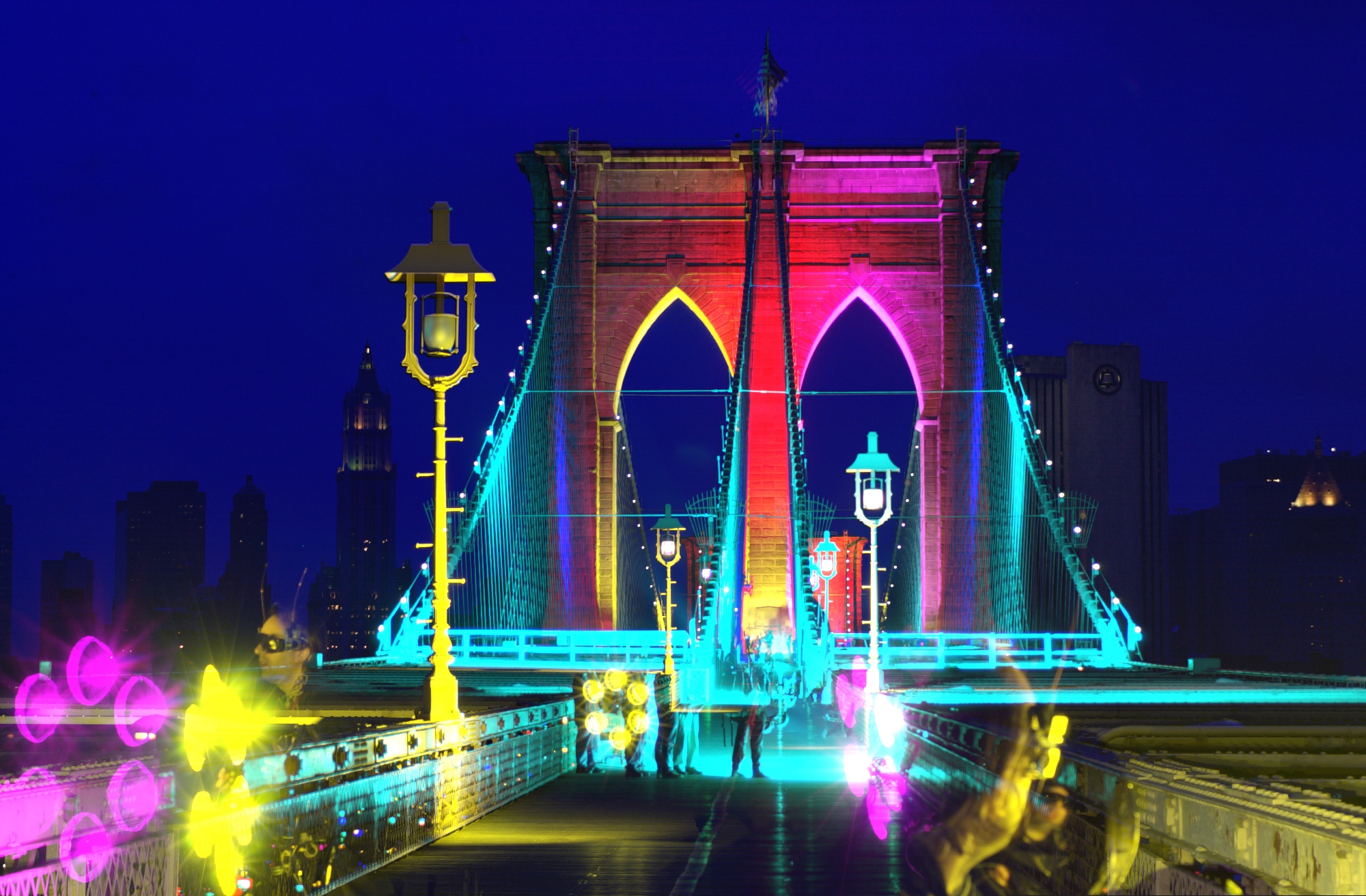
These systems, with the appropriate signal processing,
allow entire cities to be illuminated, or other large scale
subject matter such as the
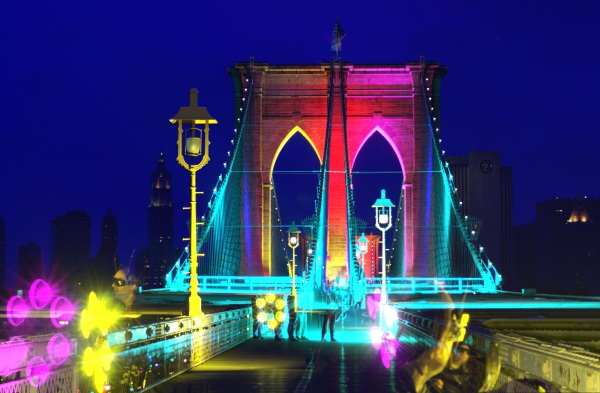
Brooklyn Bridge,
to be captured in a new and expressive light.
The wearable photographic system turns the body into a measurement apparatus
to collect data about how subject matter responds to light.
This process of creating visual art is often
a collaborative process involving a
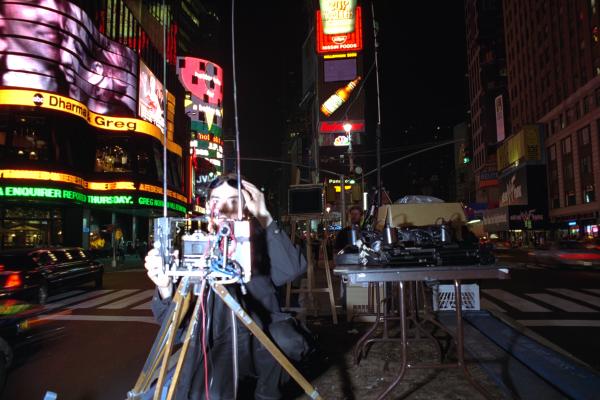 fixed base station
operated
by one person and at least one other person (usually the author)
walking around and illuminating the subject matter of a picture
in various ways.
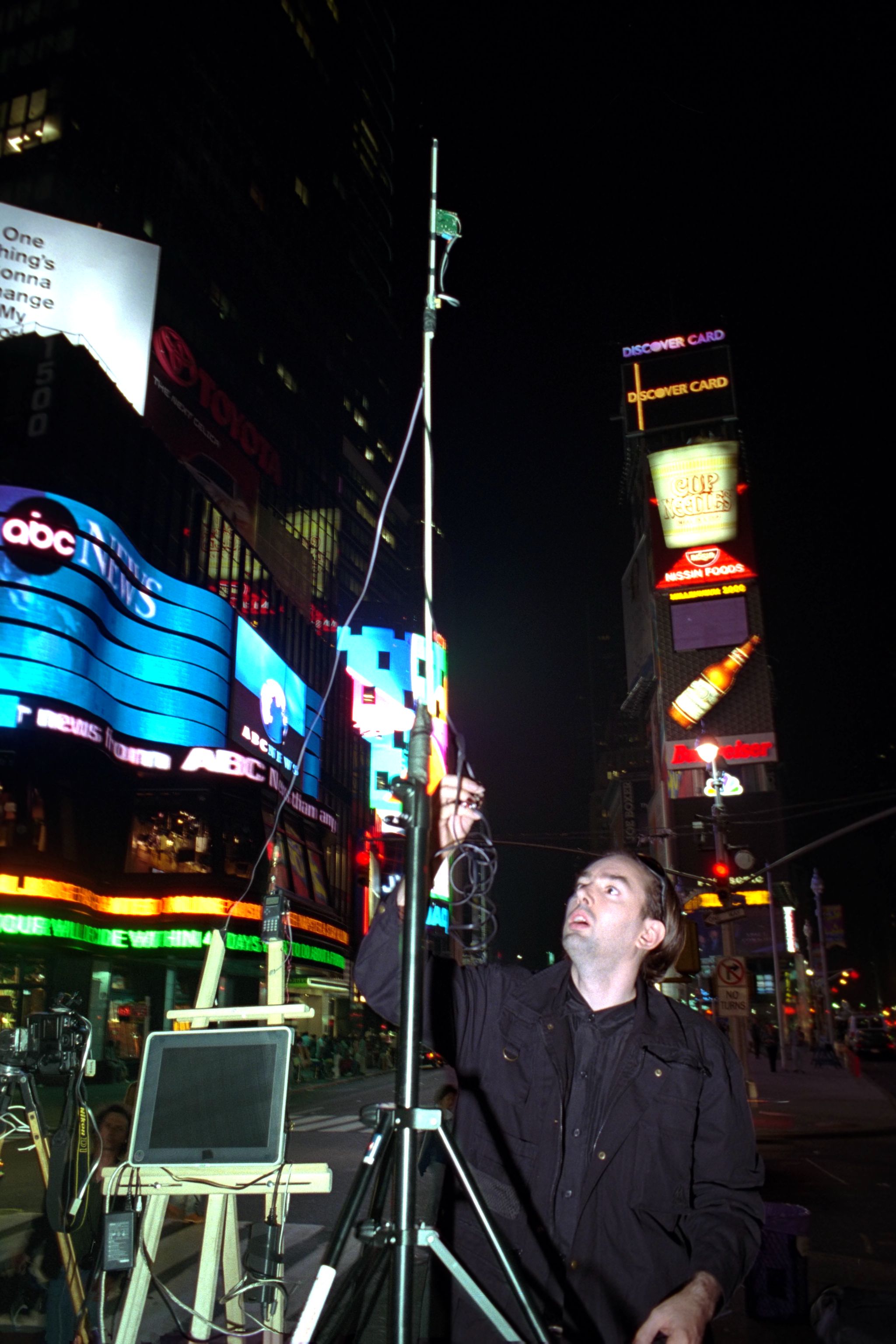
The base station is connected to the internet, and also serves as a gateway
for the wearable portion to obtain network access, through a
fixed base station
operated
by one person and at least one other person (usually the author)
walking around and illuminating the subject matter of a picture
in various ways.
The base station is connected to the internet, and also serves as a gateway
for the wearable portion to obtain network access, through a
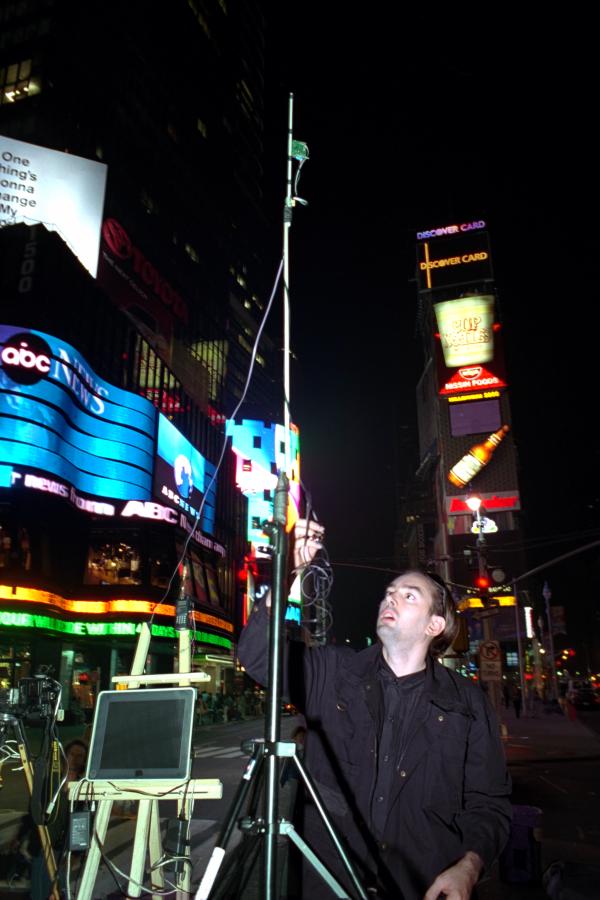 temporarily rigged antenna stand.
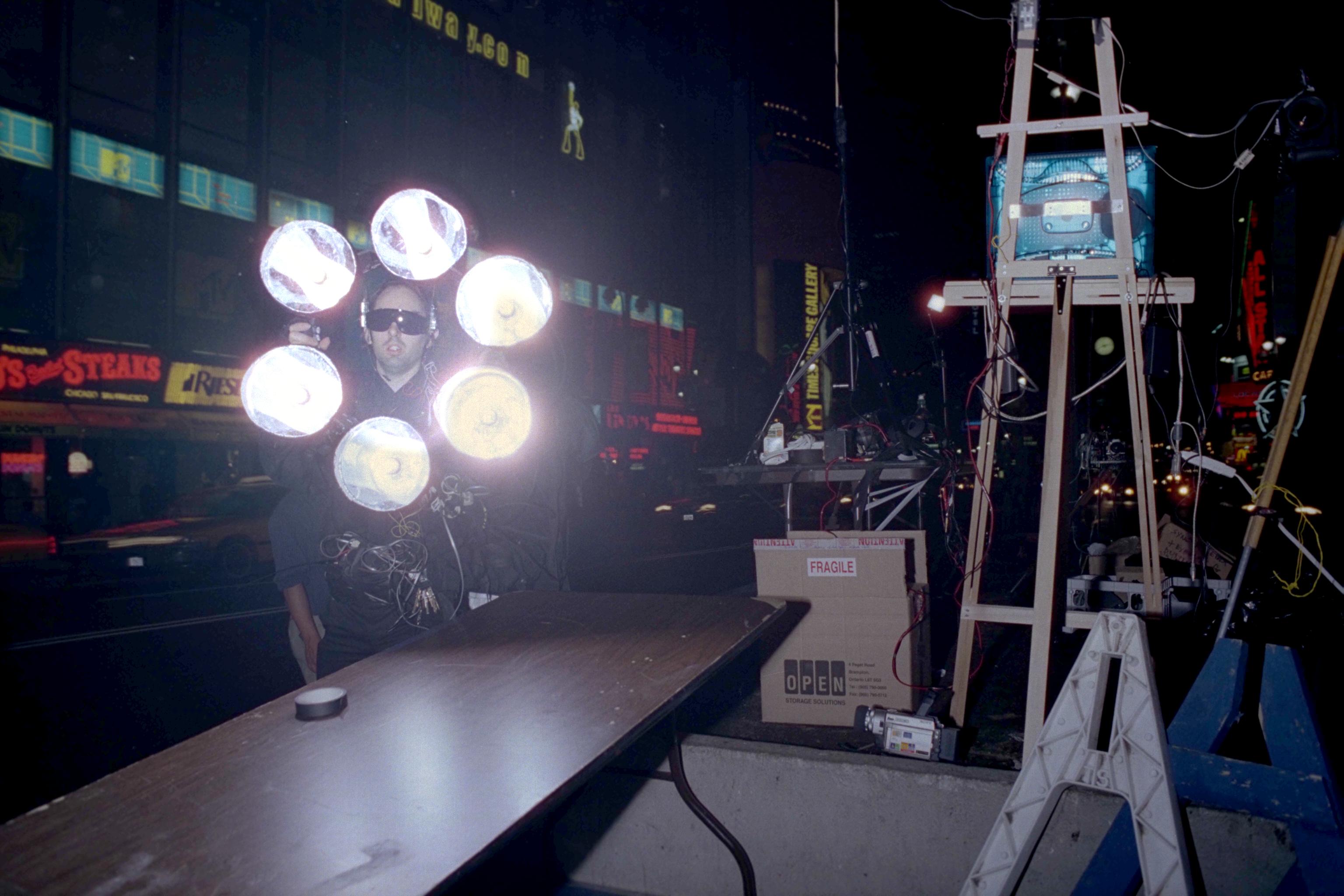
CAPTION: Setting up the base station in Times Square}
(a) A portable graphics computer and image capture camera
are set up on a tripod,
with antennas for wireless communication to the wearable graphics
processor and portable rig.
Various other apparatus is visible on the table to the right of
and behind the imager tripod.
(b) One of the items on the table
is an additional antenna stand. To the left of the antenna stand
(on the easel) is a television which displays what I call the
``lightvector painting'' as it is being generated. This television
allows the person operating the base station to see the output of
my wearable graphics processor as, for example,
I walk through Times Square
illuminating various skyscrapers with the hand held flash array
shown in the next figure.
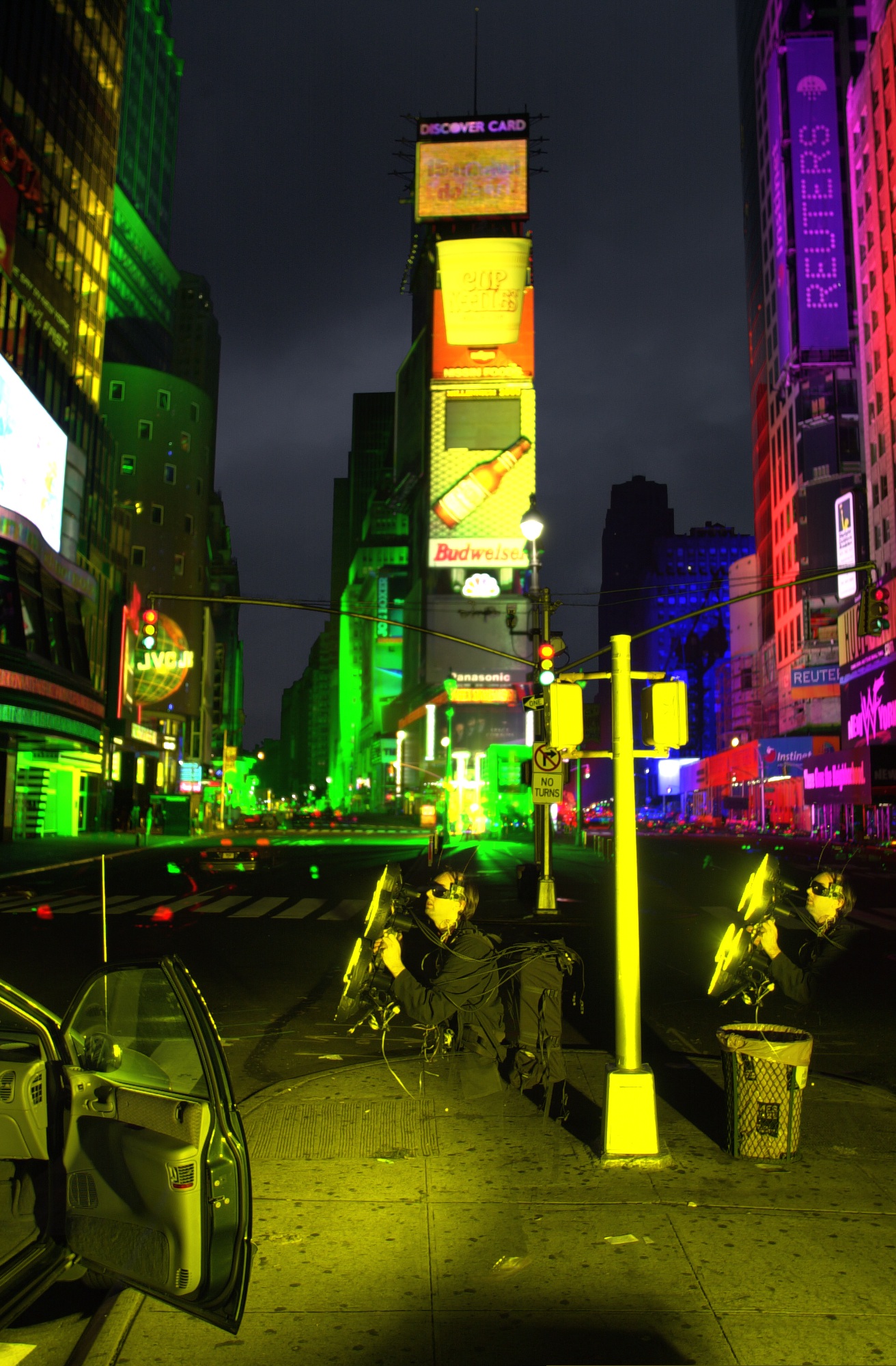
Each time the author moves to a new location and takes aim to light up
subject matter, a new ``light vector'' is generated using
the dataset from that particular lamp location and
lamp orientation.
Each such lightvector provides a description of how the
subject matter responds to light from that particular location.
Each lightvector is analogous to a brushtroke in a painting, and it is
the collection of a large number of such lightvectors that make up
an entire lightvector painting.
Using multiple lamps, as an art form, allows greater control over the system.
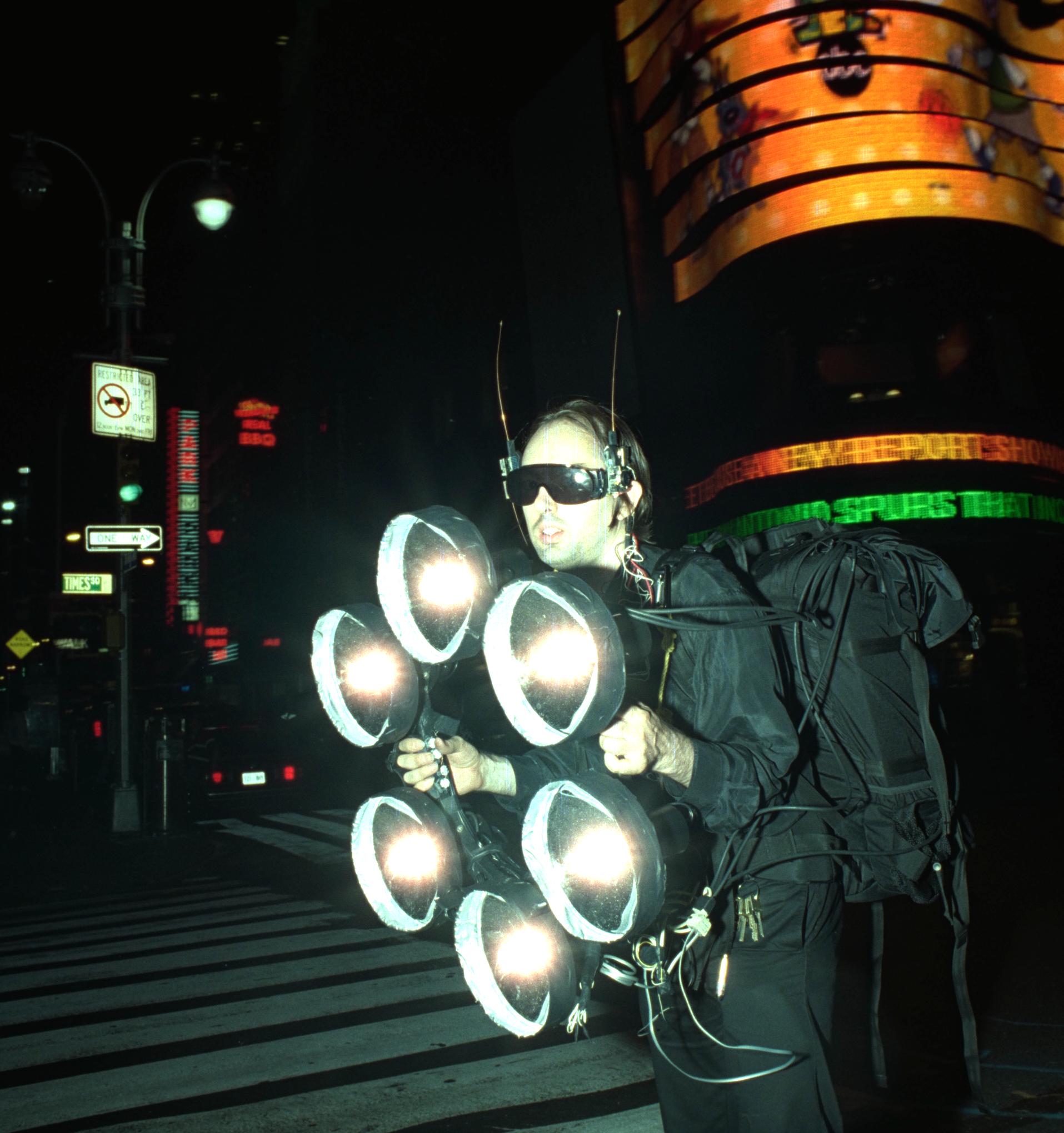
Six lamps
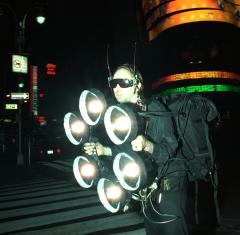 are connected to the wearable computer to provide a
powerful yet hand--held and wearable
photographic lighting studio system with wearable multimedia computer
used to illuminate various subject matter from a variety
of different locations in space.
The number six was chosen for dense hexagonal packing, but having
the seventh lamp (in the center) removable and removed for a space
in which the author could look out to view the subject matter being illuminated.
are connected to the wearable computer to provide a
powerful yet hand--held and wearable
photographic lighting studio system with wearable multimedia computer
used to illuminate various subject matter from a variety
of different locations in space.
The number six was chosen for dense hexagonal packing, but having
the seventh lamp (in the center) removable and removed for a space
in which the author could look out to view the subject matter being illuminated.
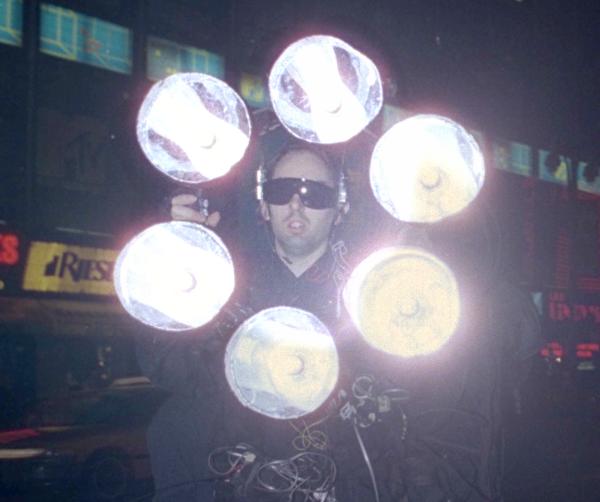 The portable nature of the
apparatus allowed it to be carried around in a collaborative
computer--mediated space.
The portable nature of the
apparatus allowed it to be carried around in a collaborative
computer--mediated space.
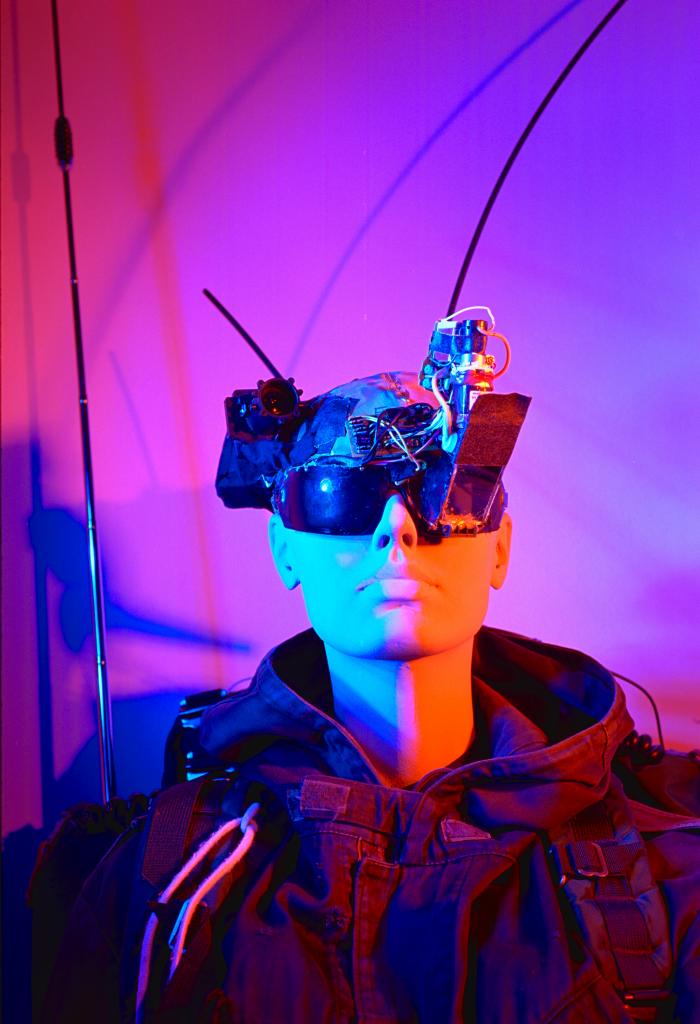
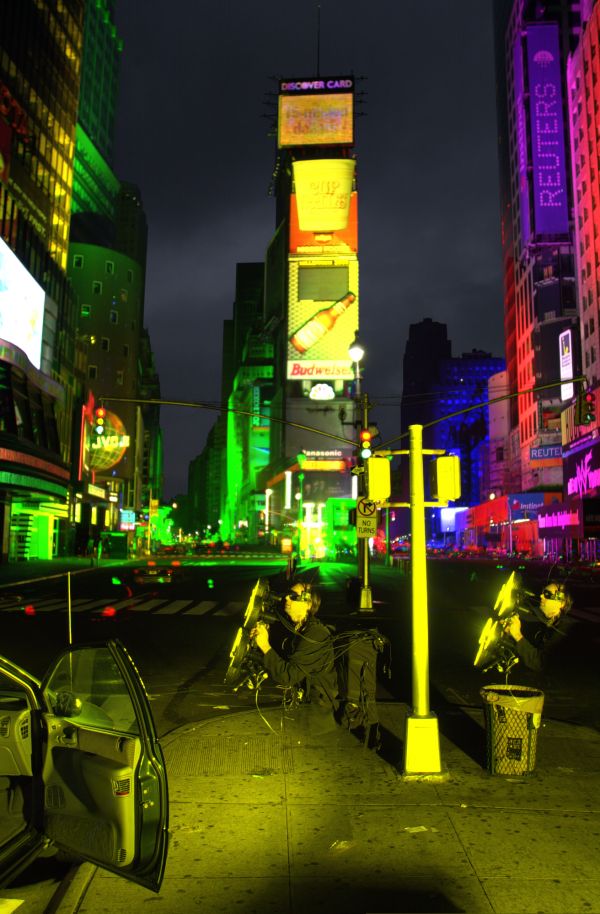
The backpack based rig used to light up various
skyscrapers in Times Square produces approximately 12 kJ of light
into six separate lamp housings, providing better energy localization
on a per--lamp basis, and giving a 100 ISO Guide Number of approx.
2000. The two antennae on the headgear wirelessly
link the computer eyeglasses to the base station shown in the
previous figure.
Within the computer mediated world, it was thus possible to make
the lights of times square weak by comparison to the small battery
powered handheld rig.
Other examples of lightvector paintings can be found in:
Collaborative projects
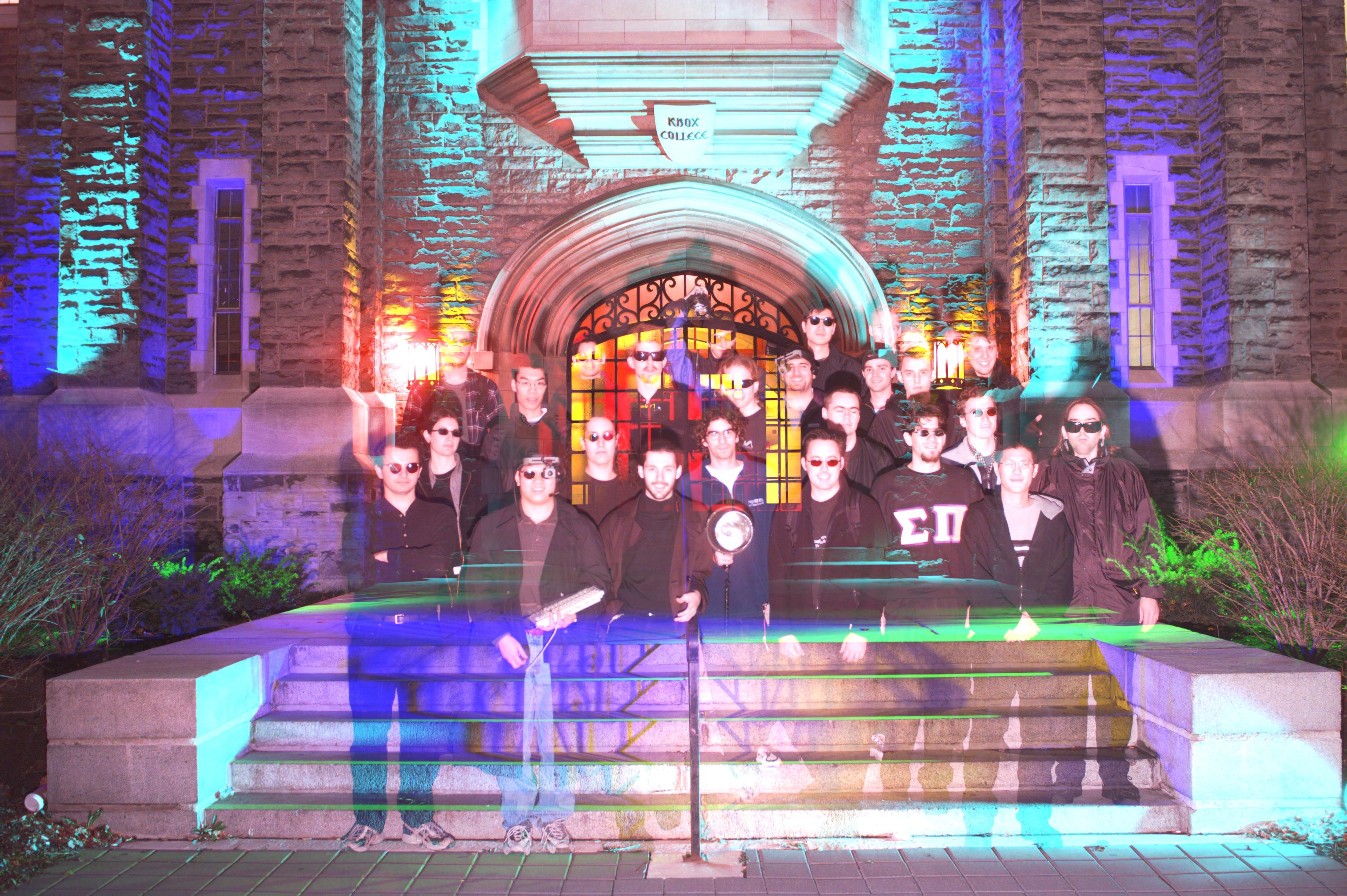
More recently, the author has taught his new art form to
some students at the University of Toronto,
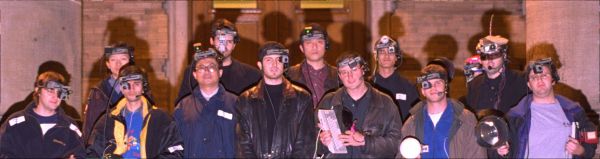 and taught these students the art of building similar rigs.
Thus twenty years later, the art has emerged from a cumbersome solo effort, to a
highly mobile team of visual artists, scientists, and engineers, able to
quickly collect and process lightvector spaces.
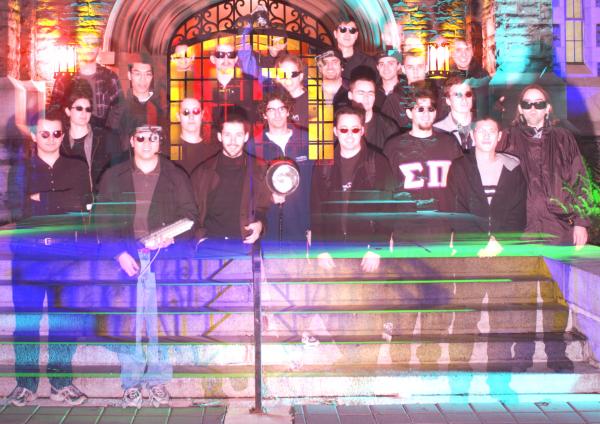 Gone are the days of the heavy cumbersome gear.
 Figure 1a
and Figure 1b.
Figure 1a
and Figure 1b.
 fixed base station
 temporarily rigged antenna stand.